
Cannabis for Health
High Dose THC Edibles in Canada: What Counts and How to Use Them
Nov
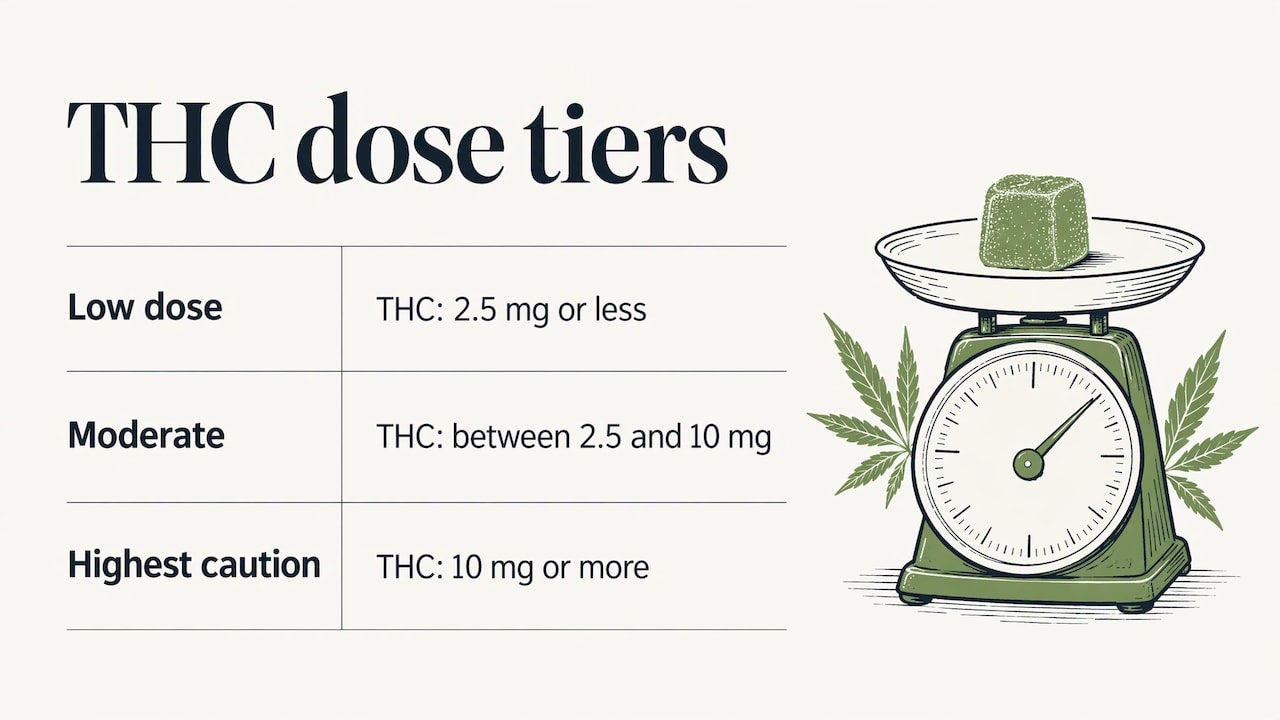
In Canada, “high dose” starts at 10 mg of THC per serving. Health Canada says 10 mg or more calls for the most caution, because higher levels can cause greater impairment and raise the risk of serious adverse effects. The same rule that defines the top of the range also sets the legal ceiling. A regulated edible package cannot hold more than 10 mg of THC in total. So the real questions for most shoppers are how to read the label, how to pace yourself, and what “strong” means once you understand the numbers.
This guide covers the dose tiers, the label math, timing, the main edible types and a step-by-step approach for adults who want a stronger experience without a bad night.
TL;DR
- Health Canada’s tiers: 2.5 mg or less is low, 2.5 to 10 mg is moderate, and 10 mg or more needs the most caution.
- Legal edible cannabis is capped at 10 mg THC per immediate container, so the label’s “Total THC” matters as much as the per-piece figure.
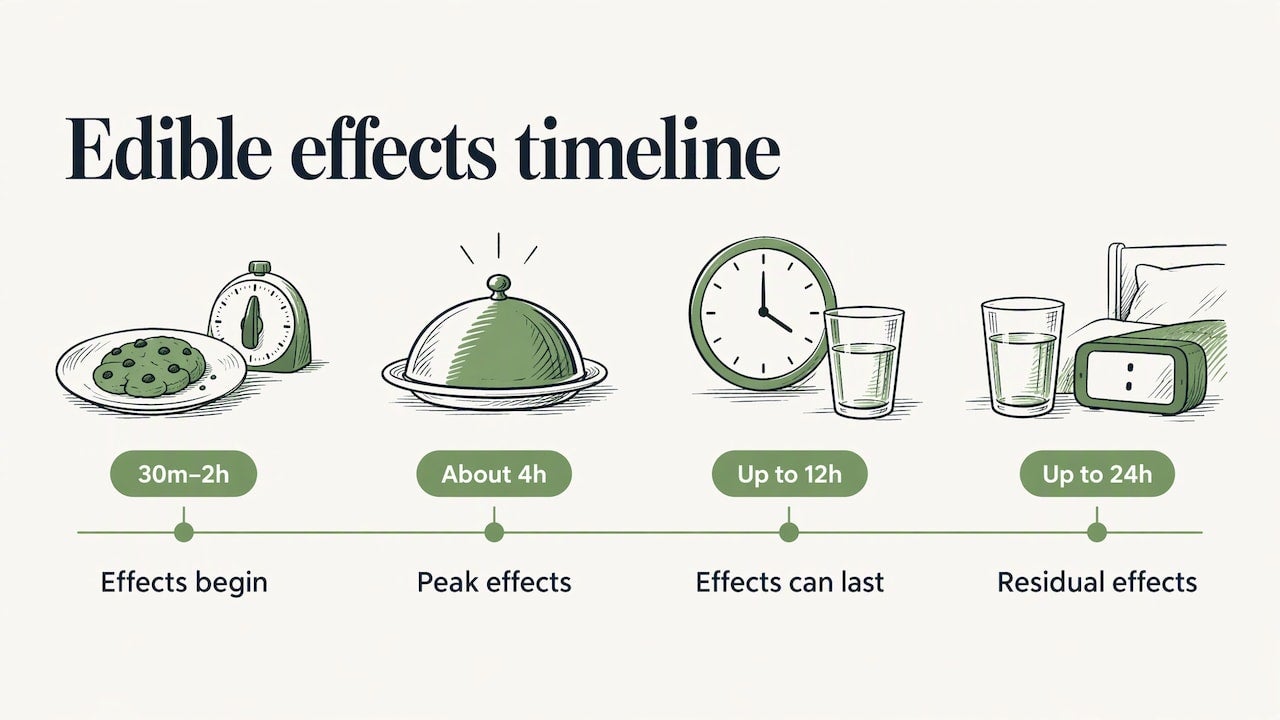
- Edibles take 30 minutes to 2 hours to start, peak around 4 hours and can last up to 12 hours.
- Wait at least 2 hours before a second dose. Eating more too soon is a common cause of overconsumption.
- Keep edibles locked up, labelled and away from children and pets.
Table of Contents
- What counts as a high dose
- What the law allows: 10 mg per package
- How to read an edible label
- How edibles work in your body
- Low dose vs. high dose: choosing for the experience you want
- Types of edibles and how they differ
- Perspective: why we start people low
- A step-by-step approach for adults
- If you take too much
- Find your range at Toke Club
- FAQ
- Sources
What counts as a high dose
Health Canada describes three tiers for cannabis you eat or drink. At 2.5 mg of THC or less, you are in the low-dose range recommended for new consumers. Between 2.5 mg and 10 mg is a moderate range that still asks for caution. At 10 mg or more, the risk of strong impairment and serious adverse effects rises, which is why that tier gets the most caution. These tiers come from the Health Canada consumer guidance.
That has a practical consequence. When people search for strong weed edibles, they often picture a 50 mg gummy or a 1,000 mg bar. Those numbers come from a different frame of reference than the one Canadian regulators use. In the guidance, a 10 mg piece is already at the top of the scale. Something that feels ordinary to a daily user may be a very large dose for someone who uses cannabis once a month.
Tolerance changes the picture, but it does not remove the need for care. The BC government’s edibles fact sheet lists metabolism, weight, sex, whether your stomach is empty and your personal tolerance as factors in how an edible feels. Two adults can eat the same piece and have very different evenings.
What the law allows: 10 mg per package
Under the Cannabis Regulations, edible cannabis may not contain more than 10 mg of THC per immediate container, taking into account the potential for THCA to convert into THC. Health Canada’s classification page adds that edible cannabis is meant to be consumed like food, while cannabis extracts follow different rules and can hold up to 1,000 mg per immediate container.
In plain terms:
- A regulated edible is capped at 10 mg for the whole package, not per piece.
- A product can be 10 pieces at 1 mg, 4 pieces at 2.5 mg, or one piece at 10 mg.
- Extracts such as oils and capsules sit under a separate category with different requirements for THC, ingredients, packaging and promotion.
If you see a product described with hundreds of milligrams of THC, check its category, its licensing status and where it comes from before you buy. Whatever the marketing says, the regulated edible limit stays at 10 mg per container, and Health Canada’s guidance on risk applies to you as the consumer.
How to read an edible label
The label is where dose confusion starts and ends. Under section 132.18 of the regulations, the label of an edible sold in discrete units must show two figures:
- Total THC per unit: the milligrams of THC each piece could yield. This is your serving.
- Total THC: the milligrams the entire package could yield. This figure must not exceed 10 mg.
Health Canada’s label guide gives a clear example: a package of four pieces labelled 2.5 mg per unit contains 10 mg in total. The CCSA infographic shows the same thing from the other side. A 10 mg package can hold pieces of 2.5 mg, 5 mg or 10 mg, depending on how many pieces there are.
A quick worked example
Suppose you pick up a bag of gummies labelled “Total THC per unit: 5 mg” and “Total THC: 10 mg.” Divide 10 by 5 and you have two gummies. One gummy is a moderate dose. Both gummies together land at the 10 mg line, the point where Health Canada says to be most careful. If you are new, or use cannabis rarely, a half gummy is closer to the 2.5 mg starting point.
Labels are accurate within a range
Labels are not perfect to the milligram. Under section 97 of the regulations, the actual THC content has to fall within set tolerances of the labelled amount:
| Labelled THC | Allowed range of actual content |
|---|---|
| Over 5 mg | 85% to 115% of the label |
| Over 2 mg up to 5 mg | 80% to 120% |
| 2 mg or less | 75% to 125% |
So a piece labelled 10 mg can legitimately hold between 8.5 mg and 11.5 mg. That is one more reason not to treat the top of the scale as a target.
How edibles work in your body
Edibles are digested, so they behave differently from inhaled cannabis. According to the BC fact sheet, effects begin 30 minutes to 2 hours after eating, peak at about 4 hours and can last up to 12 hours, with some residual effects lasting as long as 24 hours. Health Canada’s lower-risk guidance gives the same window: 30 minutes to 2 hours to feel effects and up to 4 hours for the full effect.
The delay is the central fact of edible use. The Council of Chief Medical Officers of Health notes that a delayed onset can lead to overconsumption and increase the risk of poisoning. Most uncomfortable edible stories follow the same pattern: nothing happens at 45 minutes, so someone eats more, then both doses arrive together.
If you want to know how long THC from edibles lingers after the effects fade, see our piece on how long edibles stay in your system.
Low dose vs. high dose: choosing for the experience you want
The low-dose searches outnumber the high-dose ones by a wide margin, and for good reason. Most adults who enjoy edibles for winding down at the end of the day stay in the lower part of the range. Here is a simple way to think about it.
| Dose per serving | Health Canada tier | Who it suits |
|---|---|---|
| 2.5 mg or less | Low | First-timers, infrequent users, anyone returning after a break |
| 2.5 to 10 mg | Moderate | Occasional users who know how they react |
| 10 mg or more | Highest caution | Experienced, regular consumers who plan the evening around it |
For relaxation, a smaller dose taken earlier in the evening often works better than a large one taken late. You get time to see how it develops, and the long tail of an edible is less likely to collide with your morning. Plan the setting too: a calm room, water, something to eat, no driving, and no other plans that require a clear head.
Types of edibles and how they differ
Edibles come in several formats, and format changes how the experience feels in practice.
- Gummies and jellies: easy to divide, with a consistent amount per piece. Many people like them because the dose per piece is clear on the label. Our guide to gummies versus baked goods goes deeper.
- Chocolate and baked goods: often scored into squares or portions. Portions can be less uniform than moulded gummies, so read the per-unit figure and divide carefully.
- Drinks: consumed as a beverage, which makes them easy to sip too quickly. Treat a drink as one dose and wait.
- Capsules and oils: these are usually classed as extracts rather than edibles, with their own rules. Health Canada notes that cannabis taken under the tongue may start working in 15 to 40 minutes, faster than eating or drinking it.
If you are curious how consumption styles have shifted, our article on the evolution from joints to edibles gives the background.
Perspective: why we start people low
At Toke Club, we have been serving Canadian customers since 2018, and the question we hear most is not “what is the strongest edible?” It is “how do I get the experience I want without overdoing it?”
Our view is simple. The best edible is the one you can read, measure and pace. That is why we like a wide selection: gummies, chocolates, drinks and more, so you can match the format to the evening instead of forcing one product to do everything. When you can choose between a small piece and a larger one, you can step up gradually rather than jump.
We also built the shop around easy decisions. Our loyalty program earns credits on purchases, and our edibles often carry visible savings, so trying a lower-dose product first costs you little. Start with the label, follow the guidance from Health Canada, and let your own experience tell you where your comfortable range sits.
the author
A step-by-step approach for adults
- Read both label figures. Find “Total THC per unit” and “Total THC,” then do the division so you know exactly how many servings are in the package.
- Start at 2.5 mg or less. That is the starting point named by Health Canada and the CCSA. If a piece is bigger, cut it where the product allows.
- Wait at least 2 hours. The BC fact sheet says to wait at least that long before a second dose. Full effects can take up to 4 hours.
- Step up slowly across separate occasions. Raise the dose a little the next time, not within the same night.
- Do not mix with alcohol or other substances, and do not drive. Effects can last many hours.
- Store it safely. Keep edibles labelled, apart from regular food, and out of reach of children and pets. The CCMOH warns that edibles can be mistaken for ordinary food and drink.
For a longer walkthrough aimed at newcomers, read our beginner’s guide to edible dosing.
If you take too much
The plan is boring, and that is the point: stop eating, sit somewhere calm, drink water and wait. If someone has accidentally consumed cannabis, or has consumed too much and is not well, the BC fact sheet says to seek immediate help by calling poison control or 911, or by going to a local hospital emergency department. Call right away for a child or pet that has eaten an edible, or for anyone who is very sick, confused or struggling to stay conscious. Do not wait for the symptoms to pass on their own.
Find your range at Toke Club
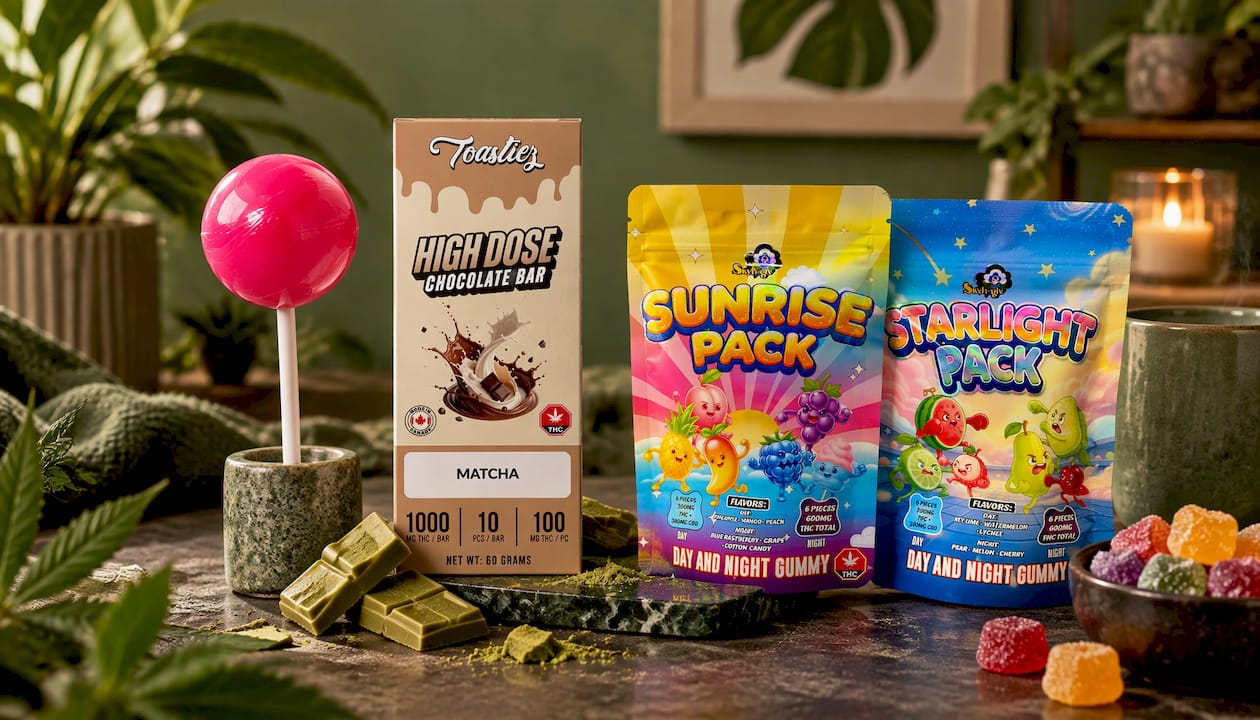
If you are ready to shop, our edibles collection lets you compare formats side by side. Read the label on each product page, work out your serving, and start at the low end. You can also look at products such as Sky High Day and Night Gummies to see how a daytime and a nighttime option can fit different parts of your routine.
Sign-ups earn rewards, and purchases earn credits through our loyalty program, so you can build up savings as you find what works. Our shop serves Canadian adults only.
FAQ
How many mg is a high dose of THC in an edible?
Health Canada puts 10 mg or more per serving in the highest-caution tier. Anything above 2.5 mg already moves beyond the low-dose starting point. Regular consumers may be comfortable at higher amounts, but the guidance says higher levels can cause greater impairment.
Can a legal edible in Canada contain more than 10 mg of THC?
No. The Cannabis Regulations cap edible cannabis at 10 mg of THC per immediate container. Extracts, such as oils, follow a separate category with a higher limit of up to 1,000 mg per container, and they carry their own rules.
How long should I wait before taking more?
Wait at least 2 hours, and remember that the full effect can take up to 4 hours to arrive. Eating more too quickly is a common cause of overconsumption, so patience is the most useful safety habit with edibles.
What is the difference between per-unit THC and total THC?
Per-unit THC is the dose in a single piece. Total THC is the amount in the whole package. A four-piece package labelled 2.5 mg per unit holds 10 mg in total.
Are low-dose edibles good for relaxation?
Many adults prefer them for unwinding because the effect is easier to predict and to pace. Starting with 2.5 mg or less and waiting for the effects is the approach recommended by Canadian health authorities.
Sources
- Health Canada: What you need to know if you choose to consume cannabis
- Health Canada: How to read and understand a cannabis product label
- CCSA: Edible Cannabis, Always Read the Label
- Health Canada: Cannabis, lower your risks
- CCMOH statement on cannabis extracts, edibles and topical products
- Health Canada: Classification of ingestible cannabis products
- Cannabis Regulations, section 102.7
- Cannabis Regulations, section 132.18
- Cannabis Regulations, section 97
- Health Canada: Using a cannabis product