
Cannabis for Health
Sugar Free THC Gummies in Canada: How to Choose and Dose
Nov
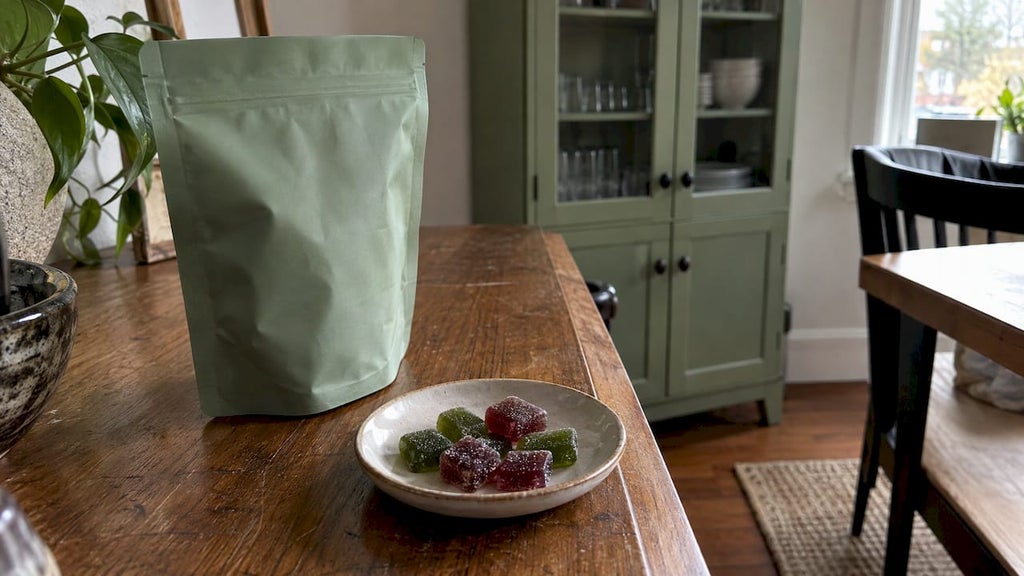
Sugar free THC gummies give you the same cannabis effect as a regular gummy, with the sweetness coming from an alternative sweetener instead of sugar. To buy them well, read the ingredient list, check the total THC per piece, and start low. Health Canada advises new consumers to look for 2.5 mg of THC or less. If you want a sugar free option you can order in Canada, our edibles category includes one, and this guide shows what to look for before you add anything to your cart.
TL;DR
-
“Sugar free” means no added sugar. The sweetness comes from another ingredient, so read the ingredient list, not just the front of the package.
-
The dose per piece matters more than the flavour. New users should start at 2.5 mg of THC or less and wait at least 4 hours before taking more.
-
Edibles can take 30 minutes to 2 hours to start working and can last up to 12 hours, so patience is the main safety tool.
-
Sugar free does not make a gummy a diabetes product. Diabetes Québec does not recommend cannabis for people with diabetes, so talk to your doctor first.
-
Store gummies in their original child-resistant package, out of sight and reach of children and pets.
Table of Contents
What “sugar free” actually means on a THC gummy
A classic gummy is built from sugar, glucose syrup and gelling agent, with THC added. A sugar free gummy swaps the sugars for a sweetener that does not count as sugar, and the THC works exactly as it would in any other gummy. The cannabis is the same. What changes is the sweetener, the texture and sometimes the aftertaste.
That makes the ingredient list the place to look. Under Health Canada’s labelling rules, sugars-based ingredients in edibles are grouped under the word “Sugars” in brackets, in descending order of weight. A genuinely sugar free gummy will not show that group. You will see its alternative sweeteners listed by name instead.
Three quick checks save you from a surprise:
-
Scan the ingredient list for the word “Sugars” or for syrups. If they are there, the product is not sugar free.
-
Note which sweetener is used. Some people find certain sweeteners leave a cooling or bitter aftertaste, and some digest them less comfortably in larger amounts.
-
Check allergens. Health Canada says edible cannabis labels must list ingredients by weight, plus food allergens, gluten and added sulphites.
One point about rules that trips people up: Health Canada’s composition guide says cannabis extracts cannot contain sugars or sweeteners. That rule is about extracts such as oils and concentrates, not about gummies, which are classed as edibles. Do not assume that a sweetener-free product means a sugar free gummy, and do not read the extract rule as a promise about any candy.
How to read the THC dose on the package
The dose is the number that decides whether your evening goes well. Health Canada says the front of every cannabis label must show total THC and total CBD. The key is to work out how much THC is in one piece, not in the whole package.
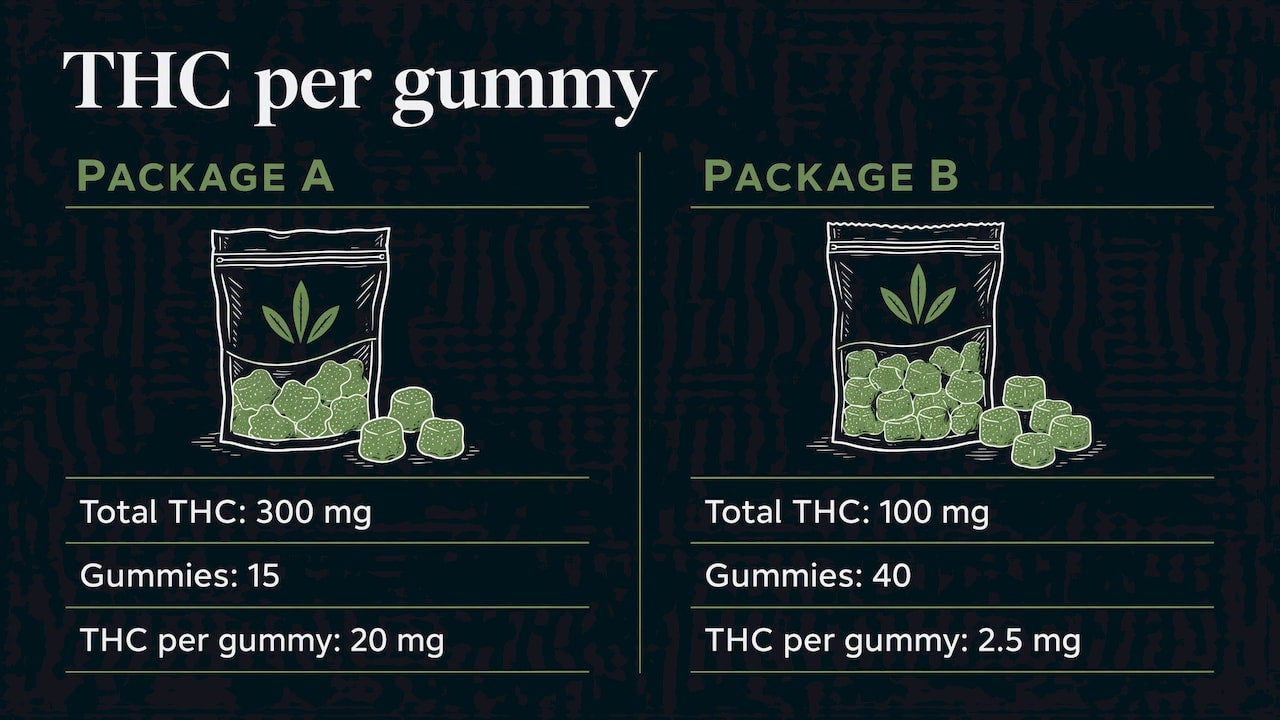
The arithmetic is simple. Divide the total THC by the number of gummies. A package with 300 mg of THC in 15 gummies holds 20 mg per gummy. A package with 100 mg in 40 pieces holds 2.5 mg each. Two packs can look similar on a shelf and differ by a factor of eight in what a single bite delivers.
Since the 2025 streamlining amendments, labels are simpler. According to a Canadian cannabis law firm’s summary, the amendments in force since March 12, 2025 simplified potency labelling to total THC and total CBD. That means the numbers you need are the ones to look for first on any package.
Typical starting points
| Experience level | Suggested THC per portion | Source of the guidance |
|---|---|---|
| New or returning after a long break | 2.5 mg or less | Health Canada |
| Starting out with edibles generally | 2.5 mg or less, wait at least 4 hours before more | Windsor-Essex County Health Unit |
| Anyone considering 10 mg or more | Extra caution | Health Canada |
If you want a step-by-step routine for working out your own dose, our beginner’s guide to edible dosing walks through it. Higher-potency products are covered in our guide to high dose THC edibles in Canada.
Timing: why patience beats a second gummy
The most common edible mistake is taking more because nothing has happened yet. Health Canada states that ingested cannabis can take 30 minutes to 2 hours to begin working and up to 4 hours for full effects. The effects can last up to 12 hours, with residual effects for up to 24 hours. The same guidance explains that the body converts ingested THC into a stronger form called 11-hydroxy-THC, which is one reason edibles feel different from inhaled cannabis.
A peer-reviewed Canadian review names this delayed onset and longer duration as the central overconsumption risk, and notes that people new to cannabis can still be caught out even when they follow dosing advice. Put plainly:
-
Take one low-dose piece.
-
Set a timer for four hours, not one.
-
Do not drive, and plan the evening around being at home.
-
Take a second piece only if you still want more after the four hours, and keep it the same size.
A worked example
Say you pick up a package of 40 gummies labelled 100 mg total THC. That is 2.5 mg a piece. You take one at 7 pm. By 8:30 pm you feel a mild change, by 11 pm it peaks, and you are comfortable. You skipped the temptation to take a second at 8 pm, which is the moment most people go wrong. If you had taken three pieces at 8 pm, all three would have been landing together around 11 pm.
Choosing a sugar free gummy that fits you
Once the label checks are done, the decision comes down to a few practical questions.
What dose per piece do you want? Match it to your experience. A low-dose piece lets you adjust in small steps. A higher-dose piece suits someone who already knows their tolerance. Our sugar free option, the Boost sugar free raspberry gummies, is listed as 300 mg THC across 15 pieces at 20 mg each, so it is a pick for experienced edible users who know that strength suits them.
How do you feel about texture and taste? Sugar free gummies often chew a little differently. Flavours like raspberry and green apple are popular because they cover any aftertaste well. If you like a classic fruity gummy, look at the other gummies in our edibles range, such as the green apple gummies or Mikro THC gummies, and compare their ingredient lists with the checks above.
Is a gummy even the right format? Gummies are discreet and measured, which is why they suit beginners. If you are weighing them against something like brownies or cookies, our comparison of THC gummies and baked goods lays out the differences in dosing consistency, taste and how quickly they work.
Sugar free is not the same as diabetes friendly
People often search for sugar free gummies because they are watching their blood sugar. This is the one place where the label cannot be taken at face value, because the question is no longer about sweeteners but about cannabis itself.
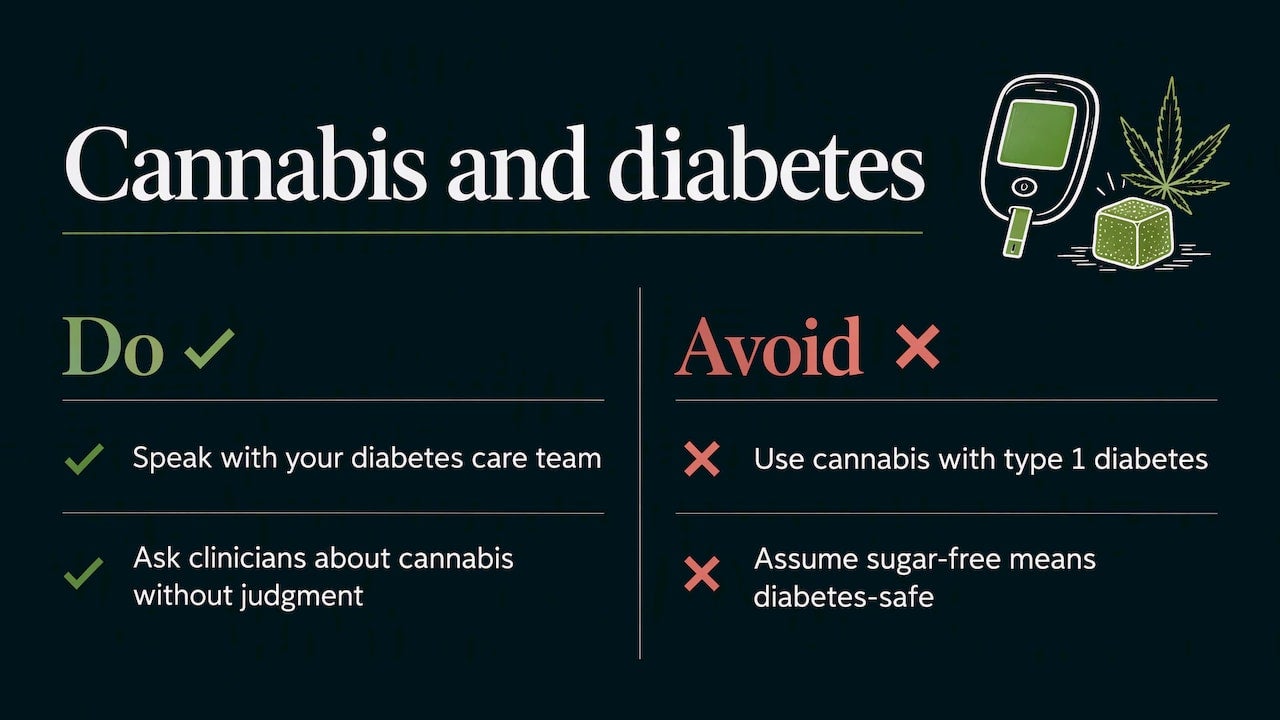
Diabetes Québec states that cannabis use is not recommended for people with diabetes, because no safety benefits have been shown and use is linked with poorer self-management. It advises people with type 1 diabetes to avoid it because of an almost doubled risk of diabetic ketoacidosis (a dangerous build-up of acids in the blood). The same page notes that cannabis can increase cravings for sweet and fatty food, can reduce how well you notice low blood sugar, and in some people causes vomiting that can lead to dehydration.
A 2020 rapid review commissioned by Diabetes Canada reached a similar conclusion. It found higher HbA1c in type 1 users and a higher risk of diabetic ketoacidosis, and concluded that the safest approach is to recommend against recreational cannabis for people with diabetes. It also says clinicians should ask about cannabis use without judgment and offer individual counselling on reducing risk to patients who intend to use it.
So if you have type 1 or type 2 diabetes, speak with your doctor or diabetes care team before you buy any THC product, sugar free or not. If you are choosing sugar free because you simply prefer less sugar, the label advice above is all you need.
Storing gummies safely
Gummies look like sweets, and that is the whole risk at home. The Canadian review of edible legalization points out that children and pets are at risk of accidental ingestion because edibles resemble candy, and it identifies children and older adults as the highest-risk groups.
A simple routine:
-
Keep gummies in their original child-resistant package. Do not decant them into a jar or a candy dish.
-
Store them in a locked box or a high cupboard, away from snacks.
-
Tell anyone in the household what the package is.
-
If a child or pet eats one, call your local poison control centre or emergency services right away.
Our perspective
We started in 2018 with a simple idea: Canadians who want cannabis should be able to find trusted products without hunting through confusing listings. Sugar free gummies are a good example of why that matters. Two packages can both say “sugar free” and still differ in sweetener, texture and, most of all, dose per piece.
That is why we put a straightforward shopping experience first. Our edibles category groups gummies in one place, so you can compare flavours, formats and strengths side by side and pick the one that fits how you actually plan to use it. Our loyalty program, which gives credits on purchases and rewards for signing up, means that once you find a gummy you like, coming back to it costs you less.
Our advice to anyone choosing a sugar free gummy is the same as what Health Canada tells new consumers: start low, go slow, and read the label before the flavour name. We built the range so that is easy to do.
the author
Where to buy sugar free THC gummies
If you are ready to shop, start with our edibles category, where sugar free raspberry gummies sit with the rest of our gummy range. Toke Club is an online marketplace for Canadians, with edibles, vapes, concentrates, flower, topicals and accessories, plus a loyalty program that earns you credits on purchases. Our site features offers such as 25% off edibles, so check the category page for what is running when you visit.
If you want to compare formats before you decide, our THC vape guide for Canada covers the faster-acting alternative to an edible, and the vapes category has the range.
FAQ
Are sugar free THC gummies weaker than regular ones?
No. The sweetener has no effect on how strong a gummy is. Strength depends on the THC per piece, which you find by dividing the total THC on the front of the package by the number of gummies. Compare that number, not the word “sugar free”.
How long do THC gummies take to work?
Health Canada says ingested cannabis can take 30 minutes to 2 hours to begin working and up to 4 hours for full effects. Effects can last up to 12 hours, and some residual effects can remain for up to 24 hours. Wait at least four hours before taking more.
How much should a beginner take?
Health Canada advises new consumers to look for products with 2.5 mg of THC or less, and to be more cautious at 10 mg or more. The Windsor-Essex County Health Unit gives the same starting point and suggests waiting at least 4 hours before having more. Begin with one low-dose piece and stay at home.
Are THC gummies bad for diabetes?
Diabetes Québec does not recommend cannabis for people with diabetes, and advises people with type 1 diabetes to avoid it because of a higher risk of diabetic ketoacidosis. A sugar free label does not change that. Speak with your doctor or diabetes care team before using any THC product.
How do I know a gummy is really sugar free?
Check the ingredient list. Under Health Canada’s labelling rules, sugars in edibles are grouped under the word “Sugars” in brackets, so a sugar free product should not show it. Its sweeteners will be listed by name instead.
Sources
-
What you need to know if you choose to consume cannabis, Health Canada
-
Guide on composition requirements for cannabis products, Health Canada
-
Classification of ingestible cannabis products: edible cannabis, Health Canada
-
The effects of recreational cannabis use on glycemic outcomes, Systematic Reviews
-
Health considerations of the legalization of cannabis edibles, PubMed Central
-
Cannabis Edibles vs Extracts: Classification Under the Cannabis Regulations