
Cannabis for Health
Cannabis for Back Pain: What the Research Shows and How Canadians Use It
Nov
Some adults living with back pain find that cannabis eases it, and the strongest recent trial data comes from chronic low back pain. The effect in controlled studies is modest, it depends on the product and the dose, and it works best as one part of a plan you build with your health care provider. This guide covers what the trials found, how THC, CBD, edibles, vapes and topicals differ, what to know about strains, and how to start carefully.
TL;DR
- A large 2025 trial of a standardized full-spectrum cannabis extract found a small but statistically significant drop in chronic low back pain over 12 weeks.
- Edible studies in people with chronic low back pain link THC-containing products to lower pain on use days. CBD-only products showed no clear same-day effect.
- No strain has been proven best for back pain. Look at the THC and CBD content first, then the terpene profile and your own response.
- Start low and go slow: 2.5 mg THC for edibles, then wait at least 2 hours. Do not drive after using.
- Health Canada advises caution for some groups, including people under 25, those who are pregnant or breastfeeding, and people with heart, liver, kidney or psychosis history. Talk to a clinician first.
Table of Contents
- What the clinical evidence says about cannabis and back pain
- THC, CBD or both: what works for which kind of pain
- Choosing a format: edibles, vapes, flower, concentrates and topicals
- Is there a best strain for back pain?
- What about arthritis pain?
- How to start safely
- Shop cannabis for back pain relief at Toke Club
- FAQ
- Sources
What the clinical evidence says about cannabis and back pain
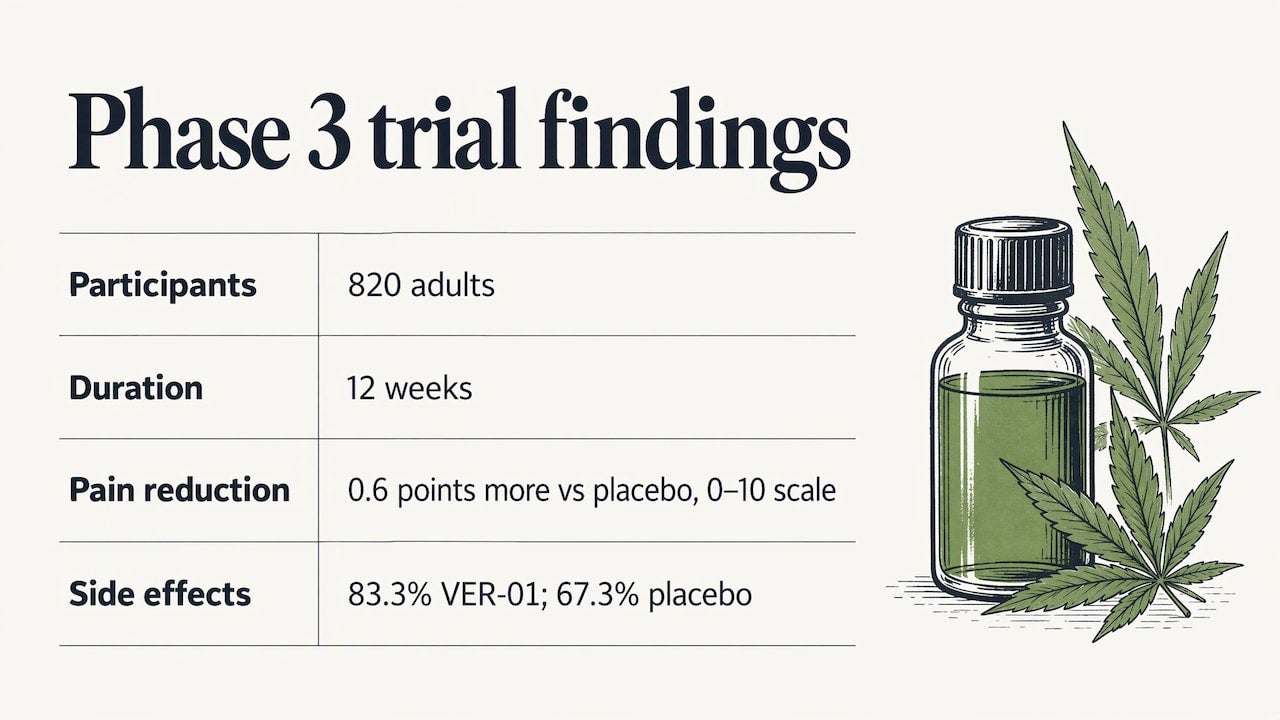
The best-known recent result is a 2025 phase 3 trial of 820 adults with chronic low back pain. Participants took VER-01, a standardized full-spectrum cannabis extract, or placebo. Pain fell by 0.6 points more on a 0 to 10 scale with VER-01 over 12 weeks (95% CI −0.9 to −0.3; P < 0.001). That is a modest gap, and it is real. Side effects were more common with the extract than with placebo (83.3% vs 67.3%), mostly mild to moderate and temporary, and the researchers saw no signs of dependence or withdrawal.
Earlier research is more mixed, which is normal for a field that is still maturing. A 2023 systematic review of 12 studies found that all the observational studies reported improvement in low back pain or related measures, while the single randomized trial it included found no significant difference from placebo. A 2026 review of randomized trials concluded that results depend on the condition, the formulation, the route and the cannabinoid mix. It reported moderate-certainty evidence for the full-spectrum extract in chronic low back pain. A single 400 mg oral dose of isolated CBD did not beat placebo in acute low back pain.
What does this mean in practice? Chronic back pain, acute back pain, and pain from arthritis are different problems. The product matters too: a trial of one extract does not tell you how every product behaves. Treat the numbers as a realistic picture of what to expect: for many people, a partial reduction rather than a cure.
How Canadian authorities describe it
Health Canada notes that products sold in Canada have not been reviewed or authorized to treat any specific disease or symptom, while available research suggests cannabis might relieve chronic non-cancer pain, mainly neuropathic pain. Its guidance for health care professionals adds that clinical studies of cannabinoids show more consistent evidence for chronic pain, especially where conventional treatments have failed.
Canadian clinical bodies take a careful line. The PEER simplified chronic pain guideline from Canadian family physicians recommends avoiding cannabinoids for most people with chronic low back pain. The Canadian Rheumatology Association takes a pragmatic position: it recognizes that many patients already use cannabis and recommends structured, time-limited trials with defined goals and follow-up rather than refusing to discuss it. The practical takeaway is to bring your doctor or pharmacist into the conversation, especially if you take other medication.
THC, CBD or both: what works for which kind of pain
The research does not treat cannabis as one thing. The cannabinoid ratio changes the picture.
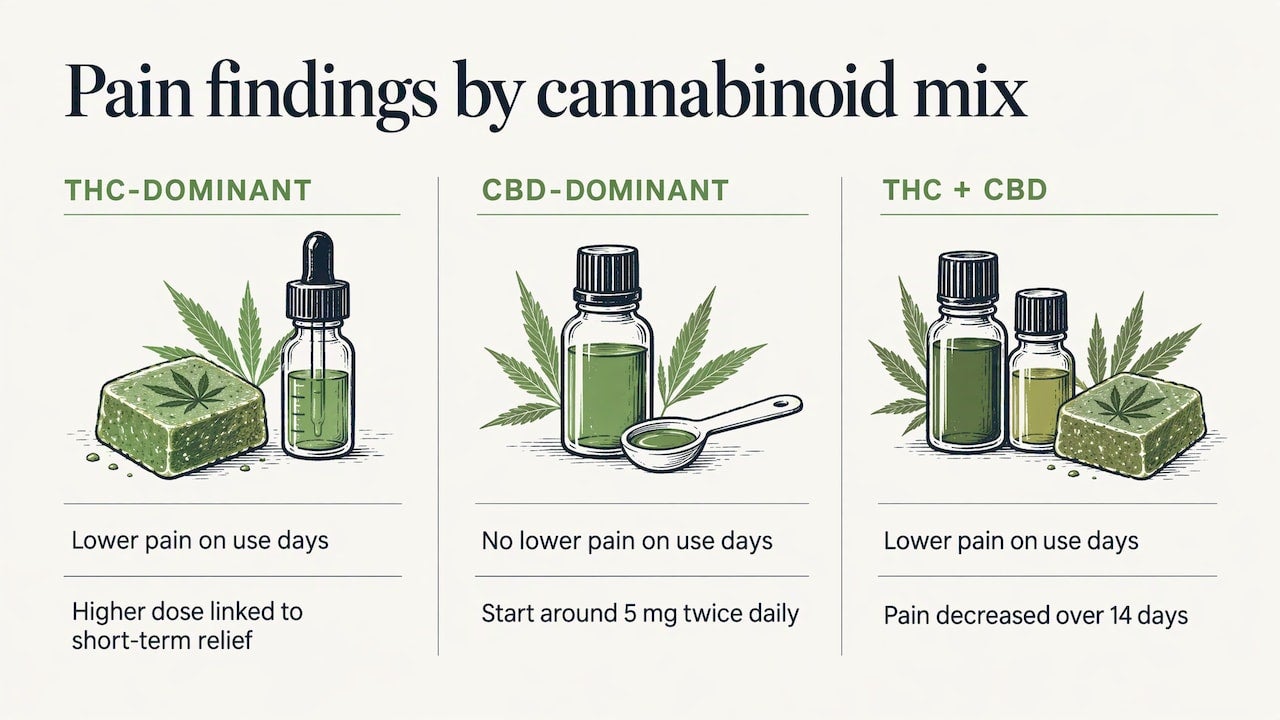
THC-containing products. In a 2024 naturalistic study of 249 people with chronic low back pain using edibles, higher THC doses were linked to short-term pain relief, while CBD dose was mainly associated with relief of tension. A 2026 secondary analysis of 243 participants found pain intensity was lower on days people used THC-dominant or THC plus CBD edibles, but not on days they used CBD-dominant products. Over 14 days, pain also decreased in the THC plus CBD group. These are observational studies, so they show associations, not proof of cause.
CBD. Health Canada says CBD does not cause a high and is not addictive. For pain, though, the isolated 400 mg dose result above is a reminder that more CBD is not automatically better. If you want to try CBD, the BMJ chronic pain guideline suggests a measured approach: start with a low-dose, non-inhaled CBD product, around 5 mg twice daily, and increase gradually. If the response is unsatisfactory, a clinician may add 1 to 2.5 mg of THC per day. The same guideline caps both at 40 mg per day in a trial.
Both together. Many people land on a balanced product because THC may carry more of the pain effect while CBD does not cause intoxication. Your own response matters more than any rule, which is why dose tracking helps (see below).
Choosing a format: edibles, vapes, flower, concentrates and topicals
The format changes how fast relief arrives, how long it lasts and how easy it is to measure a dose.
| Format | Onset | Duration | Best for | Watch for |
|---|---|---|---|---|
| Edibles | 30 minutes to 4 hours | Longer, peaks within 4 hours | Steady, all-day or overnight back pain | Easy to take too much too soon |
| Vape | Within minutes | Peaks within 30 minutes, up to 6 hours | Flare-ups needing fast action | Dose is harder to count |
| Flower | Within minutes if inhaled | Similar to vape | Users who like choosing a strain | Smoking produces combustion byproducts |
| Concentrates | Fast when inhaled | Similar, but stronger | Experienced users | High potency |
| Topicals | Local, on skin | Varies by product | Targeted spots, such as a sore lower back | Follow label directions |
Timing figures come from HealthLink BC: inhaled effects peak within 30 minutes and last up to 6 hours, with residual effects up to 24 hours, while edibles take 30 minutes to 4 hours to be felt.
On method, the Canadian Rheumatology Association advises that cannabis should not be smoked because of toxic combustion products. Vaporizing is the preferred way to inhale, and ingested cannabis may suit a regular regimen because its effects last longer. That is why many people with persistent back pain start with edibles for steady coverage and keep a vape for sudden flare-ups.
Cannabis cream, balm and topicals for sore muscles and joints
Topicals are applied to the skin over a sore muscle or joint rather than swallowed or inhaled. People often choose them for a specific area, such as the lower back, a knee or the hands, and for use alongside other methods. We do not present a topical as a treatment for back pain, and the clinical trials above did not test creams. To use one well, clean and dry the skin, apply a small amount, massage it in, wash your hands afterward, and keep it away from broken skin, eyes and mucous membranes. Follow the directions on the label for the amount and how often to reapply. Our cannabis and THC topicals category lists the balms and creams we carry.
Is there a best strain for back pain?
Short answer: no strain has been shown to be best for back pain, and labels like indica or sativa predict less than people assume. A review of the science on terpenes from cannabis and pain found that patients showed strain preferences for chronic pain linked to certain terpene profiles. It also noted that because they used whole plants, THC, CBD and other compounds prevent firm conclusions about what the terpenes themselves do. The researchers called for more clinical trials.
So choose with a practical checklist:
- Check THC and CBD percentages or milligrams. This is the number that most affects strength and the type of effect.
- Note the terpene profile if it is listed. Keep a record of what you chose.
- Consider timing. Many people prefer a heavier, sedating product at night and a lighter one in the daytime.
- Track results. Write down product, dose, time, pain level before and after, and side effects.
- Change one thing at a time. Switching strain, dose and format together makes it impossible to know what helped.
For our own take on the topic, see our guide on the benefits of different strains for pain management or browse premium flower and CBD buds.
What about arthritis pain?
Back pain and arthritis often overlap, so many readers ask about both. The Arthritis Society Canada states that medical cannabis is not a Health Canada-approved treatment for arthritis, that clinical evidence on benefits and risks is limited, and that it is usually a third-line option. It also says there is no defined effective dose and that response varies a lot from person to person. Most physicians start low and reassess for benefit and side effects. Its patient guide adds that cannabis will not treat arthritis directly or replace standard medication, but may complement other pain management. If you have arthritis, keep taking prescribed medication and tell your care team what you are adding.
How to start safely
A careful start gives you the best chance of finding a comfortable dose.
- Talk to a professional first. A doctor, nurse practitioner or pharmacist can check for interactions and your health history.
- Start low with edibles. HealthLink BC suggests starting with a low dose such as 2.5 mg THC and waiting at least 2 hours before taking more.
- Set a realistic goal. The Canadian Rheumatology Association suggests aiming for about 30% symptom relief and following up within 4 to 8 weeks of starting a trial. Its guidance also recommends products with known THC and CBD content from a legal source.
- Do not drive. The CAMH guide for pharmacists advises avoiding driving at least 4 hours after inhaling and 6 to 12 hours after ingesting, and 8 hours if you felt euphoria. Alcohol worsens impairment.
- Know who should be extra careful. Health Canada advises against cannabis during pregnancy or breastfeeding, and under age 25 unless a health care provider says the benefits outweigh the harm. The same applies with liver, kidney, heart or blood vessel disease, or a personal or family history of psychosis or schizophrenia.
Also see worrying symptoms through. New numbness, weakness in a leg, loss of bladder or bowel control, or pain after an injury needs medical attention, not a product.
Our perspective on cannabis for back pain
We started Toke Club in 2018 because Canadians who wanted legal cannabis kept running into a hard-to-navigate market. When customers ask us about back pain, we hear the same thing: they want options they can measure and adjust, not promises.
That is why we think a wide selection matters. A person managing a stiff lower back may want a low-dose edible for the evening, a vape for a flare-up and a topical for one sore spot. Our catalogue covers edibles, vapes, flower, concentrates, topicals and accessories so that you can build a routine step by step.
We design our shopping experience around simplicity and value: clear categories, regular discounts and a loyalty program that gives credits on purchases. We believe an informed adult with good information and a low starting dose is well placed to find what suits them.
the author
Shop cannabis for back pain relief at Toke Club
If you have talked it through with your care team and want to try a product, we make it easy to compare formats in one place. Browse our edibles for slow, steady options, our topicals for targeted use, or the full Toke Club shop. New members can earn rewards for signing up, plus credits on purchases.
For more background first, read our article on whether marijuana helps relieve chronic pain.
FAQ
Is cannabis effective for back pain?
It can help some people, but the effect in trials is modest. A 2025 phase 3 trial found a 0.6-point larger drop on a 10-point pain scale than placebo over 12 weeks. Results vary by product, dose and type of pain, so work with your clinician to set goals.
How much CBD will help with back pain?
There is no proven dose. A single 400 mg oral dose of isolated CBD did not beat placebo for acute low back pain in a 2026 review. The BMJ guideline suggests trials begin around 5 mg twice daily and increase slowly, with a clinician guiding any THC addition.
Do CBD gummies really help with back pain?
In a 2026 analysis of people with chronic low back pain, CBD-dominant edibles were not linked to lower pain on use days. THC-dominant and THC plus CBD edibles were. CBD may help with tension, so some people use balanced gummies.
Can I use cannabis cream or balm on a sore back?
Many people use topicals on a specific sore area. Apply a small amount to clean, dry skin, wash your hands afterward, avoid broken skin and follow the label. Trials on back pain have focused on oral extracts and edibles, so topicals are best seen as a targeted, complementary option.
Which strain is best for back pain?
No strain has been proven best. Start with the THC and CBD content, then consider terpene profile and timing, and keep notes on how each product affects your pain and your day.
Sources
- Full-spectrum extract from Cannabis sativa DKJ127 for chronic low back pain (Nature Medicine, 2025)
- Medical Cannabis and Its Efficacy/Effectiveness for the Treatment of Low Back Pain (systematic review, 2023)
- Efficacy and Safety of Cannabinoid-Based Interventions for low back pain (2026)
- Health Canada: Cannabis for medical purposes
- Health Canada: Information for health care professionals on cannabis and cannabinoids
- PEER simplified chronic pain guideline
- Canadian Rheumatology Association position statement (Journal of Rheumatology, 2019)
- Edible cannabis for chronic low back pain (Frontiers in Pharmacology, 2024)
- Lower Pain Intensity Is Associated with the Use of edible cannabis (Biomedicines, 2026)
- Medical cannabis or cannabinoids for chronic pain (BMJ guideline, 2021)
- HealthLink BC: Cannabis use
- CAMH Cannabis Care Guide for Pharmacists
- Analgesic Potential of Terpenes Derived from Cannabis sativa
- Arthritis Society Canada: Medical cannabis
- Arthritis Society Canada: Talking to your doctor about medical cannabis
Recommended
- The Benefits of Different Cannabis Strains for Pain Management
- Cannabis for Medical Use in Canada
- Cannabis and Mental Health: Understanding the Potential Benefits and Risks
- Does Marijuana Help Relieve Chronic Pain?