Cannabis for Health
Concentrates vs Flower: Differences, Potency and How to Choose
Nov
Flower is the dried cannabis bud. A concentrate is an extract of the plant with far more THC per gram. Flower suits you if you want a gradual, familiar experience and the full plant aroma. Concentrates suit you if you already have tolerance, want a small amount to go a long way, or want less plant matter and odor. We sell both at Toke Club, so you can compare flower and concentrates in one order. This guide covers what the numbers mean, what Canadian health bodies say about each form, and how to start well.
TL;DR
-
Flower is dried bud. Concentrates are extracts that carry much more THC by weight, often several times more.
-
Higher THC does not always mean a proportionally stronger high. Research found blood THC spiked far higher with concentrates, yet reported intoxication was similar.
-
Inhaled cannabis of either kind starts working within seconds or minutes and lasts roughly 2 to 4 hours.
-
Start low with any concentrate, and use only legal, regulated products.
-
Canada’s public possession limit counts 1 gram of concentrate as equal to 4 grams of dried cannabis.
Table of Contents
What is the difference between flower and concentrates?
The Government of Québec describes dried cannabis as made mainly from the plant’s flowers, which can be rolled into a joint, smoked in a pipe or bong, or heated in a vaporizer. You are consuming the whole bud, with its cannabinoids, terpenes and plant material.
A concentrate is an extract. Québec’s guidance explains that extracts are made with solvent or physical methods, and that a concentrate is always an extract, though not every extract is a concentrate. The Canadian Pharmacists Association’s Cannabasics guide says concentrates carry higher cannabinoid levels than bud, which is why they are more potent. It sorts them into two families:
-
Solvent-based: made with carbon dioxide or alcohol, producing shatter, wax or oil.
-
Non-solvent: made with water, scraping or dried resin, producing hash and kief.
In practice, “concentrate” covers many textures. Shatter is glassy and brittle, budder and wax are soft and creamy, crumble is dry and flaky, and hash is pressed resin. Our budder and wax range shows how different the same family can look and feel.
Where vape oil fits
Many readers ask how cannabis vape oil differs from dabbing. Québec’s guidance reserves the word vaping for a liquid cannabinoid extract with a diluent such as glycerol or propylene glycol, used in a disposable pen or a cartridge on a battery. Dabbing or vaporizing the pure product is sometimes grouped under “vaping” too, but it is a different product. Health Canada’s label guidance lists vape liquids, kief, hash, resin, rosin, wax and shatter together as cannabis extracts, and requires a health warning in a yellow box on the front of the label.
So a vape cartridge is a concentrate in a convenient format. A pen needs no rig and no torch, which is why many first-time extract users start with our vapes.
How potency compares
Potency is the headline difference, and the figures are consistent across sources. Canadian data on average THC by product type is limited, so the clearest public numbers come from Washington State, where regulators report that in 2022 flower averaged 21% THC and concentrates averaged 69%. Concentrates such as wax, rosin, shatter and hash oil generally ran 60 to 90%, and kief and hash 50 to 80%.
The Canadian Centre on Substance Use and Addiction notes that extracts can reach up to 99% THC.
| Flower | Concentrates | |
|---|---|---|
| What it is | Dried bud | Extract of the plant |
| Typical THC (Washington State, 2022) | 21% average | 69% average, 60 to 90% for most types |
| Plant matter | Yes | Little or none |
| Typical formats | Joints, pipes, bongs, vaporizers | Dabs, vape pens and cartridges, added to flower |
| Amount per session | Larger | Much smaller |
A practical consequence: the same session can use a pinch of concentrate or a gram of flower. That is why a concentrate gram and a flower gram are not interchangeable when you compare price per gram.
Does higher THC mean a stronger high?
Not always. A University of Colorado Boulder study found that concentrate users’ blood THC spiked to 1,016 micrograms per milliliter shortly after use, against 455 for flower users. Yet self-reported intoxication and measures of balance and cognitive impairment were remarkably similar across both groups.
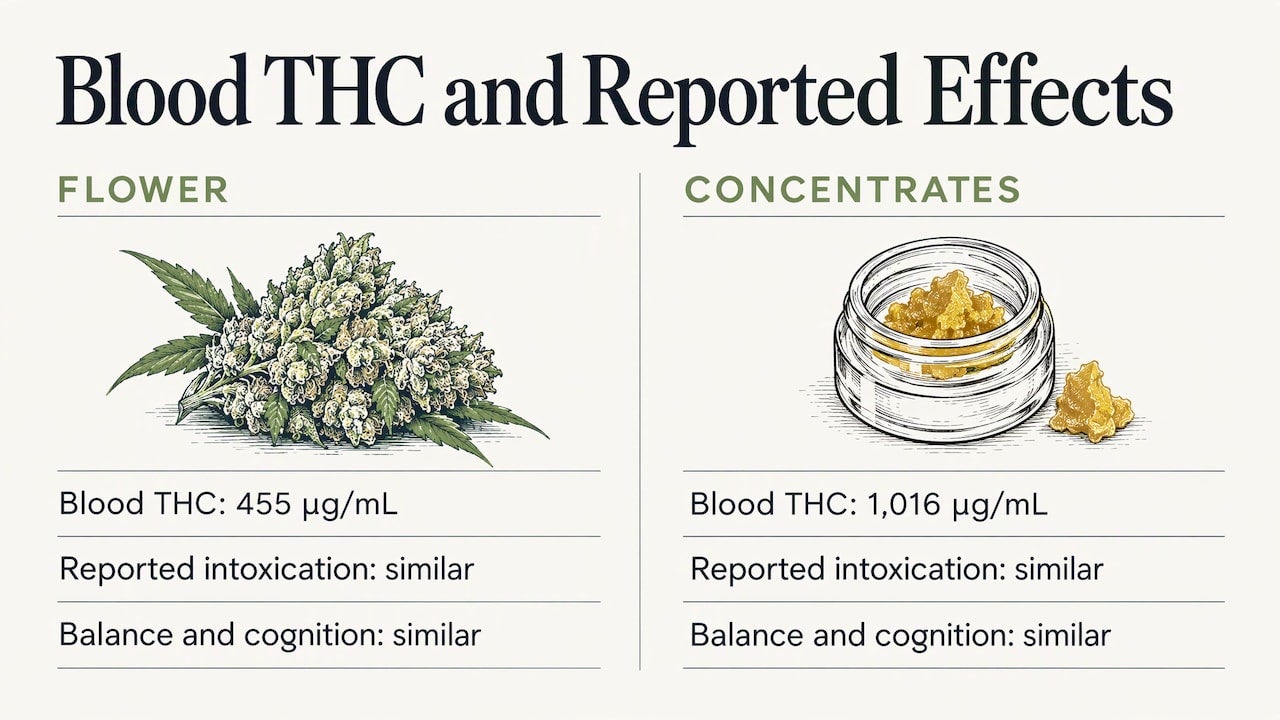
The takeaway is useful when you shop. A bigger percentage on the label does not simply multiply the experience. Your tolerance, how deeply you inhale and how much you use matter as much as the number. It also means a small amount of concentrate is plenty, and that a flower user who wants a familiar effect has no need to switch.
Terpenes shape the experience too. Flower keeps its full aromatic profile, and many extracts are made to preserve it. If you want to understand what drives aroma and effect, our piece on the science of terpenes is a good companion read.
Onset and duration
Health Canada’s guidance for medical users says that when vaping dried cannabis or extracts such as vape liquids, wax, shatter or dabs, effects start within seconds or minutes, peak after 10 to 30 minutes and last 2 to 4 hours. Smoking flower follows a similar fast timeline, so inhalation is the right pick when you want to feel the effect quickly and judge your dose as you go.
If you want a slower, longer experience, edibles work on a different clock. They are a separate category, and our edibles range is there when you want to skip inhalation altogether. Canadian regulations cap a discrete edible unit at 10 mg of THC, which makes dosing predictable.
Smoking, vaping and dabbing: what Health Canada says
The method matters as much as the form. Health Canada states that smoking is the most common method of consuming cannabis and is associated with bronchitis, lung infections, chronic cough and increased mucus. It says vaping is less harmful for the lungs than smoking, while noting that the aerosol still contains substances to be aware of.
This is a real point in favor of vaporized formats. Flower can be vaporized in a dry-herb device rather than burned, and extracts can be used in a cartridge or a dab setup. Comparing a vape with a joint is therefore partly a comparison of heat and combustion, not only of flower against extract. Our accessories and vape batteries cover the hardware side.
Safe use: who should take extra care
Health Canada’s guidance states that higher-THC products such as vapes and concentrates raise the risk of psychotic symptoms, dependence and mood disorders, and that avoiding smoking reduces the risk of heart and lung disease. Its facts for adults aged 18 to 25 add that concentrates like shatter, wax and dabs can worsen paranoia and psychosis, and that an estimated 1 in 11 people who use cannabis over a lifetime will become addicted, rising to 16% for those who start in adolescence.
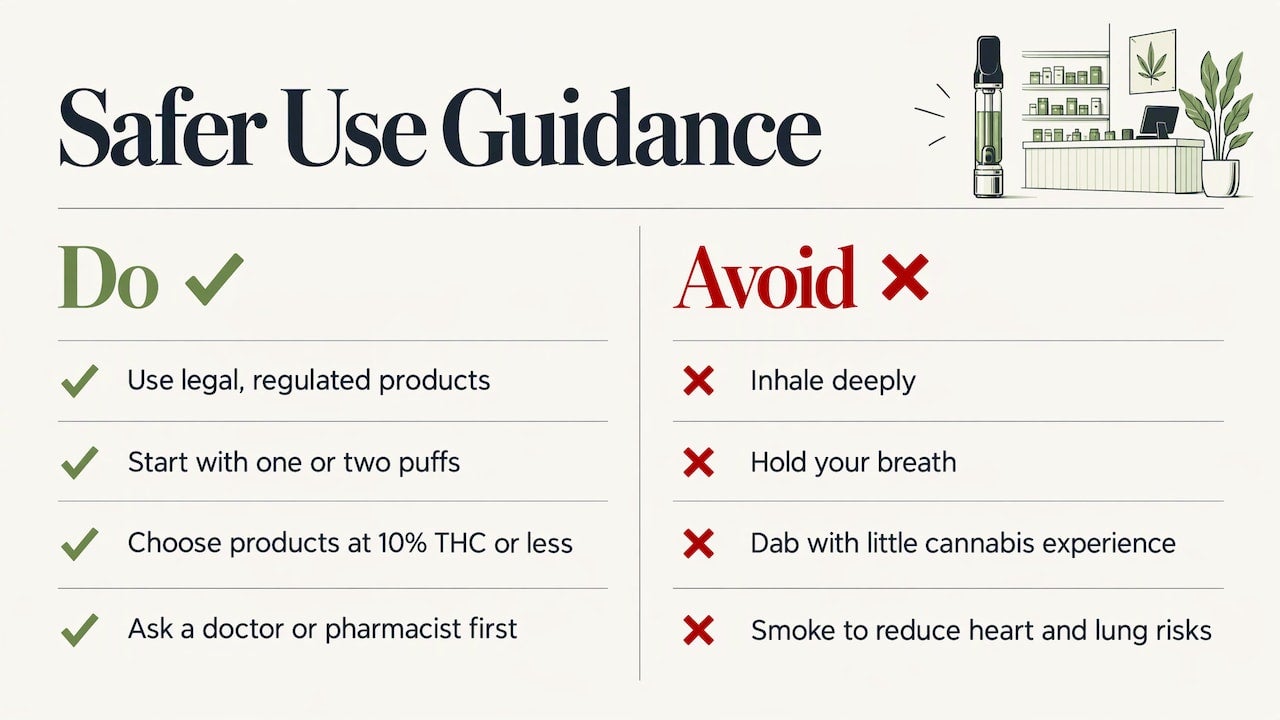
For anyone who chooses to vape, the Council of Chief Medical Officers of Health advises using only legal, regulated products, starting with one or two puffs of a product at 10% (100 mg/g) THC or less, and avoiding deep inhalation and breath-holding.
The CCSA’s primer adds that high-THC extracts increase the risk of over-intoxication, especially when dabbed, and that dabbing is not recommended for people with little cannabis experience. Health Canada’s medical guidance suggests beginning with only one or two inhalation sessions a day.
If you take medication, have a heart, lung or mental health condition, are pregnant or breastfeeding, or have a personal or family history of psychosis, speak to your doctor or pharmacist before using any inhaled cannabis. Cannabis is for adults only.
Concentrates vs flower: which one suits you?
Choose flower if
-
You are new to cannabis or returning after a long break.
-
You enjoy the aroma, look and ritual of bud.
-
You want to adjust your dose gradually, one inhalation at a time.
-
You like variety, with many strains and terpene profiles to explore.
Choose concentrates if
-
You have established tolerance and want a stronger product in small amounts.
-
You prefer less smoke, less odor and no plant matter.
-
You want a pen that is easy to carry, as with a cartridge or disposable.
-
You are happy to learn a new method such as dabbing or loading a pen.
What about cost?
Concentrates often cost more per gram, but you use far less per session, so the cost per session can be lower or similar. The comparison only works if you compare sessions, not grams. Our site shows current prices on each category page, and the loyalty program earns credits on purchases.
How we think about the choice
Most of the questions we hear from new customers come down to one worry: will this be too much? The answer is rarely about the percentage on the label. It is about matching the form to your experience and starting small.
At Toke Club we built the shop so you can see flower, concentrates, vapes, edibles and topicals side by side. That matters because the right answer is often a combination. Many people keep flower for relaxed evenings and a vape pen for a quick, discreet session.
Our advice is simple. If you are newer, begin with flower or a lower-THC vape and take one or two inhalations. If you have tolerance and want a cleaner, more compact product, a concentrate is a strong choice, and a pen is the easiest way in. Buy from regulated products, keep the label, and store everything out of reach of children and pets.
the author
Shop flower and concentrates in one place
Toke Club is an online marketplace for Canadian adults, established in 2018, with premium flower, concentrates, vape pens, edibles, topicals, accessories and mix and match bundles. New customers get rewards for signing up, and purchases earn loyalty credits. Start with the concentrates and extracts or browse premium flower, and add accessories in the same order.
If you want to try both forms, pair a disposable vape with a small amount of bud, then compare how each one feels at your own pace.
FAQ
Are concentrates better for you than flower?
Neither is simply better. Concentrates have less plant matter but far more THC per gram, and Health Canada flags higher-THC products for extra care around mental health and dependence. The method matters too: Health Canada says vaping is less harmful to the lungs than smoking. Choose the form and method that fit your experience.
Is smoking flower or dabbing worse?
They carry different risks. Smoking exposes the lungs to combustion, which Health Canada links to bronchitis, chronic cough and lung infections. Dabbing delivers very high THC, and the CCSA notes a higher risk of over-intoxication, especially for inexperienced users. Starting low and using regulated products reduces risk with either.
How much flower does it take to make 1 gram of concentrate?
For legal possession, Canadian regulations treat 1 gram of concentrate as equal to 4 grams of dried cannabis. Real extraction yields vary with the plant material and the method used. The legal figure is the one that matters for the 7.5 gram public possession limit.
Is a vape cartridge the same as flower?
No. A cartridge holds a liquid cannabinoid extract, often mixed with a diluent, while flower is dried bud. Vape cartridges usually have much higher THC and need only a puff or two. Dry-herb vaporizers heat flower itself, which is a separate device type.
Sources
-
How to read and understand a cannabis product label, Health Canada
-
Understanding THC Concentration and Potency, Washington State Liquor and Cannabis Board
-
Edible Cannabis, Cannabis Extracts and Cannabis Topicals, CCSA
-
Marijuana concentrates sharply spike THC levels, University of Colorado Boulder
-
Cannabis for medical purposes: Using a cannabis product, Health Canada
-
Is cannabis safe to use? Facts for youth aged 18-25, Health Canada
-
CCMOH statement on cannabis extracts, edibles and topical products