
Cannabis for Health
Marijuana for Anxiety: A Canadian Guide to Choosing Safely
Nov
If you are thinking about marijuana for anxiety, the choice that matters most is not the strain name. It is the dose and the THC-to-CBD balance on the label. Low amounts of THC and a CBD-forward product are the sensible place to start, and a slow, measured first session keeps the experience calm. This guide explains how the two main cannabinoids behave, how to read a Canadian label, and how to start with edibles, vapes or flower. We carry all of them at Toke Club, so you can browse our edibles once you know what to look for.
TL;DR
- THC works in two directions: Health Canada’s guidance for professionals describes low doses as calming and higher doses as anxiety-provoking, so start small.
- CBD is not intoxicating, so a CBD-dominant or balanced product is the usual starting point for anxious beginners.
- Read the THC and CBD milligrams on the label. CAMH says no evidence supports choosing by indica, sativa or hybrid name.
- With gummies, start at 2.5 mg THC or less and wait at least 4 hours before taking more.
- If anxiety is constant, or you have a personal or family history of mental health disorders, talk to a doctor before using cannabis.
Table of Contents
- Why dose decides how cannabis feels
- THC and CBD: what each one does
- What counts as high THC in Canada
- Strain names versus the numbers on the label
- Gummies and edibles for anxiety
- Vapes, concentrates and flower
- Social anxiety: plan the setting, not just the product
- Use that raises risk
- When to talk to a doctor first
- Shop with a plan at Toke Club
- Our perspective
- FAQ
- Sources
Why dose decides how cannabis feels
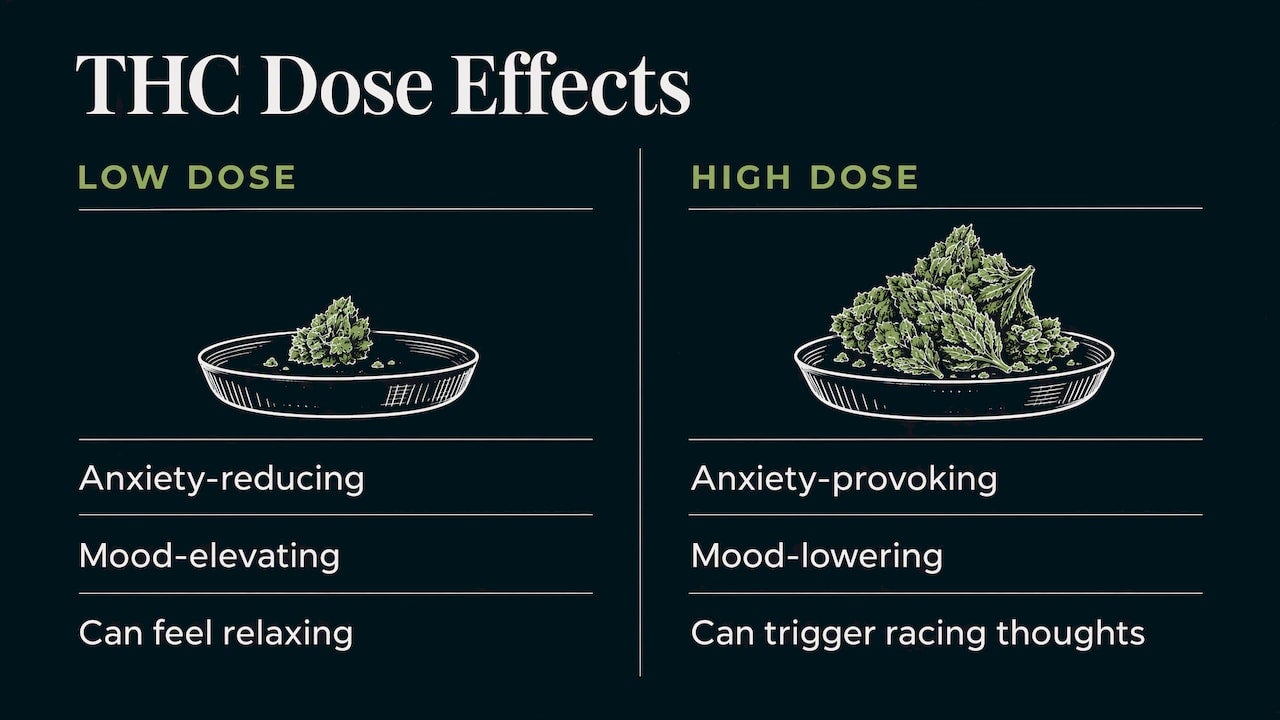
The most common mistake with cannabis and anxiety is treating THC as one steady effect. Health Canada’s guidance for health care professionals says THC has biphasic effects on mood: low doses are anxiolytic (anxiety-reducing) and mood-elevating, while high doses are anxiogenic (anxiety-provoking) and mood-lowering. In plain terms, a small amount can feel relaxing and a larger amount of the same product can tip you into racing thoughts.
A 2022 review of recent findings on THC, CBD and anxiety reaches a similar picture: the recent literature supports anxiety-provoking effects of THC, and those effects are attenuated among regular users. Tolerance changes the math, which is why a dose that suits a daily user can overwhelm someone who rarely uses.
That is why every recommendation below comes back to the same habit: pick a low-THC product, measure it, and give it time to work before adding more.
THC and CBD: what each one does
THC is the compound that produces the high. Health Canada’s consumer information describes it as intoxicating, impairing and with addictive potential, while CBD is not intoxicating. CBD (cannabidiol) has minimal psychoactive effects and, according to the 2022 review above, does not bind strongly to the cannabinoid receptors that THC acts on. Researchers have proposed that it interacts with serotonin receptors instead.
Two practical points follow from that.
CBD does not have to be maximized. The same review notes a bell-shaped dose response for CBD, where higher doses may block the calming effect rather than strengthen it. More milligrams is not automatically better.
Ratio matters. A product with as much or more CBD than THC feels different from a high-THC product. Health Canada’s warnings say higher THC increases the risk of paranoia, anxiety and dependence. Those warnings took effect on March 12, 2025 and now appear on Canadian packaging.
If you want to read more about CBD and mood on our site, see our piece on the effects of CBD on mood regulation.
What counts as high THC in Canada
Health Canada’s mental health guidance treats a product as high in THC when it has more than 10% THC or more than 10 mg THC per serving, and it advises people to choose lower-THC products. That is a useful line to keep in your head when you shop.
It also helps to know where the market sits. A study of products sold through Ontario’s legal retail market in early 2022 found that most inhalation products contained 20% THC per gram or more: 94% of dried flower, 96% of cartridges and 100% of resin. Ingestible products, by contrast, averaged about 4 mg THC per unit. In other words, if you are sensitive to THC, you will need to look for the lower end of the range on purpose, and the label is where you find it.
Strain names versus the numbers on the label
Searches for the best strain for anxiety are common, and many shoppers assume indica relaxes while sativa energizes. CAMH, Canada’s largest mental health teaching hospital, addresses this directly in its product-selection tips: many people believe indica, sativa and hybrid strains have different therapeutic effects, but there is no evidence to guide product selection by plant strain.
So here is a more reliable way to shop:
- Check the THC percentage or milligrams per unit.
- Check the CBD content next to it.
- Compare the ratio. Balanced or CBD-forward products are the gentler starting point.
- Treat strain names as a flavor and aroma preference, not a promise about mood.
CAMH’s guidance for clinicians suggests a high-CBD, low-THC oil with no more than a 1:10 THC to CBD ratio, with individualized titration. Titration means increasing the dose in small steps. Its example schedule starts CBD at 2.5 to 5 mg, raising it every 3 days to a maximum of 40 mg a day, and starts THC at 1 to 2.5 mg, raising it every 5 days to a maximum of 40 mg a day. That is clinical guidance for medical use, but the principle applies to anyone: go slowly, change one thing at a time, and keep notes.
If you are exploring cannabis under medical supervision, our page on cannabis for medical use in Canada explains the broader landscape.
Gummies and edibles for anxiety
Thc gummies and other edibles are popular with new users because the dose is printed on the package and there is no smoke. They also behave very differently from inhaled cannabis, and the timing is where people get caught.
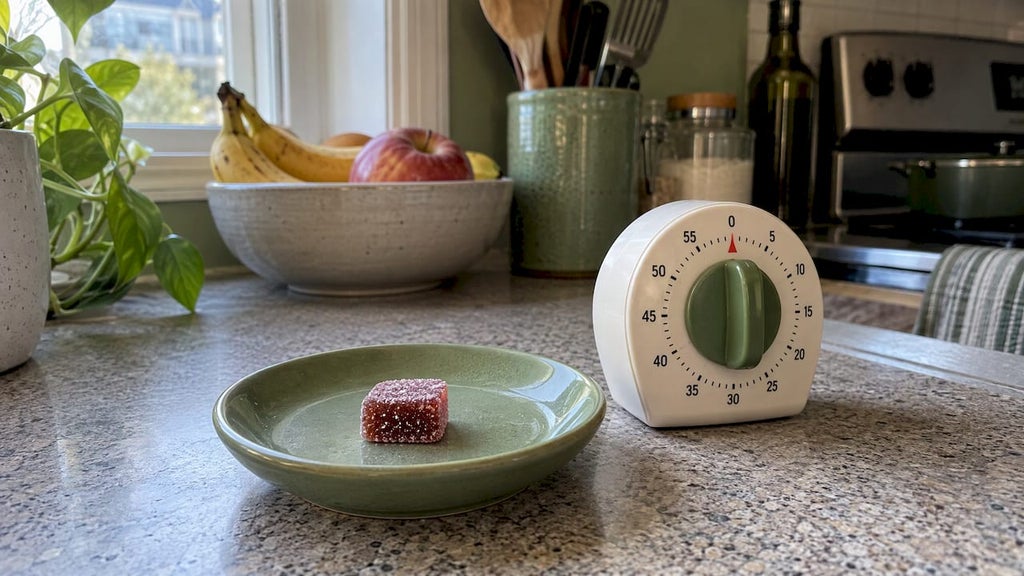
The Windsor-Essex County Health Unit advises starting with 2.5 mg THC or less per edible portion, with equal or higher CBD, and waiting at least 4 hours before taking more. It also says ingested cannabis can take up to 2 hours to start working, up to 4 hours to reach full effect, and that effects can last 12 to 24 hours. The same page lists severe anxiety or panic, paranoia, a racing heartbeat, fainting and chest pain as signs of overconsumption, and says not to drive or do safety-sensitive activities after consuming.
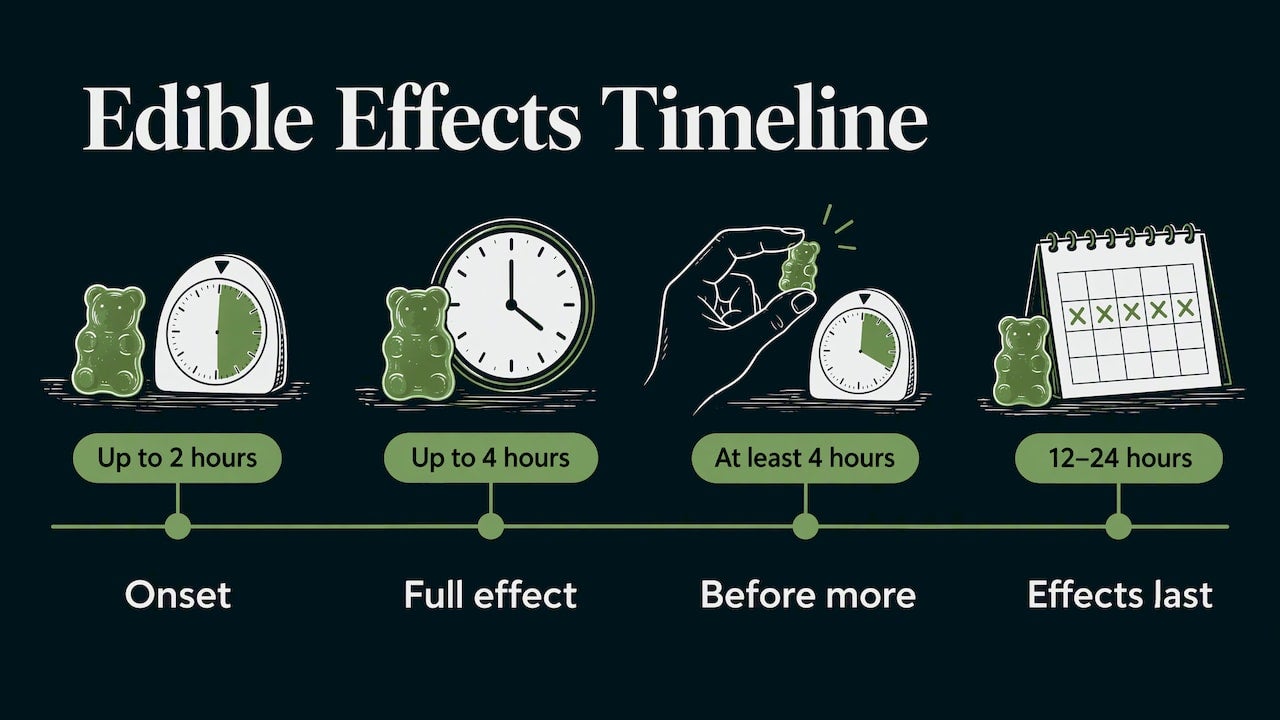
That timeline is why the classic edible mistake is taking a second gummy at the 45-minute mark. Anxiety-prone users feel that mistake most.
A sensible gummy routine
- Pick a product with a low THC amount per piece and CBD equal to or higher than the THC.
- Take a single piece, or half a piece if it is higher than 2.5 mg THC.
- Do it at home, on a day with nothing to do, with water and a snack nearby.
- Wait the full 4 hours before deciding whether to take more.
- Write down the product, the dose and how you felt, so the next session is better informed.
We stock a wide range in our edibles category, and if you are comparing dose levels, our guide to high-dose THC edibles in Canada explains what counts as high and how to read it on the pack.
Vapes, concentrates and flower
Inhaled products act fast, which some people like because they can judge the effect within minutes. The trade-off is that potency is easy to overshoot. Concentrates are the most potent form, and as the Ontario retail study showed, resin and cartridges are almost always at 20% THC or above. If you are new, or prone to anxiety, small amounts matter more here than anywhere else.
Practical habits for inhaled products:
- Take one small puff, then wait several minutes before the next.
- Look for products where CBD is listed alongside THC, and read both numbers.
- Keep sessions short and in a calm place, not before a social event or a commute.
- Do not combine with alcohol. Health Canada’s mental health guidance lists this among its recommendations for lower-risk use.
If you prefer the vape format, our vapes category and disposable vapes are where to compare cartridges and pens. For flower and CBD buds, see our flower category, and for extracts, our concentrates page. Health Canada also notes that non-inhalable forms such as oils, edibles and capsules are an option if you would rather avoid smoke.
Curious how cannabis feels across the stimulant and depressant spectrum? Our explainer on whether weed is a stimulant or a depressant covers that.
Social anxiety: plan the setting, not just the product
People searching for weed for social anxiety are often thinking about parties or dates. This is where the biphasic effect of THC is most relevant. A dose that feels pleasant alone can make you more self-conscious in a crowd, and the timing of an edible makes it hard to adjust once you are out.
A few ways to take that into account:
- Try any new product at home first, never for the first time at the event itself.
- Choose the lowest THC amount you can, with CBD at least equal.
- Leave plenty of time for onset, remembering edibles can take up to 2 hours.
- Plan your ride home. Impairment is real, and you should not drive after using.
Use that raises risk
Frequency is as important as the product. Health Canada says daily or near-daily use over time can increase the chances of developing anxiety and depression disorders, and that daily or most-days use can lead to dependence. Its 2025 warning messages also state that cannabis can cause psychotic symptoms such as severe paranoia, with the greatest risk for people under 25 or those using high-THC products.
To keep use in a lower-risk range, Health Canada recommends:
- Avoid daily or near-daily use.
- Delay use until after age 25, because cannabis can interfere with brain development up to about that age.
- Choose lower-THC products.
- Avoid mixing with alcohol.
You can find more on this in our article on cannabis and mental health and our guide to cannabis and wellness.
When to talk to a doctor first
See a doctor or another healthcare professional before using cannabis if any of these apply:
- You have a personal or family history of a mental health disorder, including psychosis, schizophrenia or substance dependence. Health Canada advises avoiding cannabis in that situation.
- Your anxiety is constant, is getting worse, or interferes with work, sleep or relationships.
- You take prescription medication and are not sure how cannabis would interact.
- You are under 25, pregnant or breastfeeding.
- You find it hard to cut back on your own. Health Canada recommends reaching out to a trusted person or a healthcare professional, since reducing or stopping frequent use can be difficult alone.
If panic, severe paranoia, chest pain or fainting follow a dose, treat it as a medical situation and call 911 or your local emergency number.
Shop with a plan at Toke Club
We are an online marketplace for Canadians, established in 2018, offering edibles, vapes, concentrates, premium flower, topicals and accessories. If you have decided to try a lower-THC product, start in the edibles category, where you can compare pieces by THC and CBD content, or visit our homepage to see the full range. Our loyalty program earns you credits on purchases, so repeat orders add up.
We sell to adults in Canada only, and this article is general information, not medical advice.
Our perspective
Most people who write to us about anxiety are not looking for the strongest product. They want to feel steady, and they are worried about the opposite. That is the right instinct, and it shapes how we think about the whole catalogue.
We see the label as the starting point of every good purchase. THC and CBD amounts per piece, per gram or per cartridge tell you far more than a strain name, and Canadian health bodies agree on that. That is why we want shopping at Toke Club to be easy to read: clear categories, a wide selection so you can match a product to your tolerance, and edibles in small doses next to higher ones, so you can begin at the gentle end.
Our approach is simple. Start low, pick a format that suits your day, measure, wait, and keep notes. A marketplace with edibles, vapes, flower, concentrates and topicals under one roof lets you adjust one variable at a time instead of starting over. Since 2018 we have aimed to make buying cannabis in Canada straightforward and trustworthy, and our loyalty credits reward you for coming back once you have found what suits you.
the author
FAQ
What kind of cannabis is gentlest for someone who gets anxious?
Start with a low-THC product where CBD is equal to or higher than THC. Health Canada considers more than 10% or 10 mg THC to be high, and it advises choosing lower-THC products. Keep the dose small and wait before taking more.
How long do THC gummies take to work?
The Windsor-Essex County Health Unit says edibles can take up to 2 hours to start and up to 4 hours for full effect, and that effects can last 12 to 24 hours. That is why it advises waiting at least 4 hours before taking more, and starting at 2.5 mg THC or less.
Does the strain matter for anxiety?
CAMH says there is no evidence to guide product selection by indica, sativa or hybrid plant strain. Use the THC and CBD numbers on the label to compare products, and treat strain names as a matter of taste and aroma.
Can cannabis make anxiety or paranoia worse?
Yes, particularly at higher THC doses. Health Canada’s warnings state that higher THC increases the risk of paranoia, anxiety and dependence, and that severe paranoia is most likely under age 25 or with high-THC products. Using low doses, avoiding daily use and not mixing with alcohol reduce that risk.
Is a vape or a gummy better for a first try?
Both can work if you keep the dose small. Gummies have a printed dose per piece but a slow onset, so patience is essential. Vapes act within minutes but are often high in THC, so take one small puff and wait.
Sources
- Health Canada: Cannabis and mental health
- Health Canada: Cannabis health warning messages
- Health Canada: Consumer information on cannabis
- Health Canada: Information for health care professionals on cannabis and cannabinoids
- CAMH: Tips for product selection
- Windsor-Essex County Health Unit: Cannabis edibles
- THC, CBD, and Anxiety: A review of recent findings
- On offer to Ontario consumers three years after legalization
Recommended
- Cannabis and Mental Health: Understanding the Potential Benefits and Risks
- Cannabis and Wellness: Integrating Marijuana into a Healthy Lifestyle
- Does Marijuana Help Relieve Depression?