
Cannabis for Health
Start Low, Go Slow: A Canadian Guide to Cannabis Dosing
Nov
“Start low, go slow” means taking a small amount of THC first, then waiting until you feel the full effect before you take more. Health Canada’s guidance puts numbers on it: 2.5 mg of THC or less for an edible, and one or two puffs of a vape or joint with 10% THC (100 mg/g) or less. The rest of this guide shows how to apply those numbers to the products you will actually buy, and how to choose them so the plan is easy to follow.
TL;DR
- Start with 2.5 mg of THC or less in an edible, then wait at least two hours before even thinking about a second dose.
- For a vape or joint, take one or two puffs of a product at 10% THC or less, and give it up to 30 minutes.
- Edibles act slowly and last long, so the most common mistake is taking more too soon.
- Concentrates and extracts are high in THC, and Health Canada says new or occasional users should avoid them.
- Never combine cannabis with alcohol or driving, and store edibles in their child-resistant packaging.
Table of Contents
- What “start low, go slow” actually means
- Starting doses by product type
- Edibles: the waiting is the hard part
- Vapes and flower: fast onset, same discipline
- Concentrates: why they come later
- A first-session plan you can follow
- Safety around the dose
- Choosing products that fit the plan
- Our perspective
- FAQ
- Sources
What “start low, go slow” actually means
The phrase has two halves, and both matter. “Start low” is about the amount of THC, the compound that causes the high. “Go slow” is about time: how quickly you consume and how long you wait between doses.
This is not a niche tip. The Council of Chief Medical Officers of Health frames it as the core harm-reduction principle for anyone who chooses to use cannabis, because the route, the dose and the speed of consumption all influence whether you have a bad reaction. Health Canada says it applies to all users until they understand how their own body responds. That includes people coming back after a long break, and people switching to a product type they have not used before.
Why a small first dose? Because the same number on a label does not hit everyone equally. The British Columbia government’s edibles fact sheet notes that body weight, metabolism, sex and whether you ate on an empty stomach all change how an edible feels and how long it lasts. You cannot predict your reaction from a friend’s. You find it out by starting small.
Starting doses by product type
Here is the starting point for each common format, using Canadian public health sources. Onset is when you start to feel it. Duration is how long effects can last.
| Product | Suggested starting amount | Onset | Typical duration |
|---|---|---|---|
| Edibles and drinks | 2.5 mg THC or less | 30 minutes to 2 hours, full effect up to 4 hours | Up to 12 hours or more |
| Vape or joint | 1 to 2 puffs at 10% (100 mg/g) THC or less | Seconds to minutes, full effect up to 30 minutes | Up to 6 hours or more |
| Extracts and concentrates | Avoid as a new or occasional user | Fast when inhaled | Strong effects |
The edible and vape figures come from Health Canada, and the onset and duration ranges match Ottawa Public Health’s lower-risk cannabis page. Treat them as ranges, not promises. Your own timeline can sit anywhere inside them.
Edibles: the waiting is the hard part
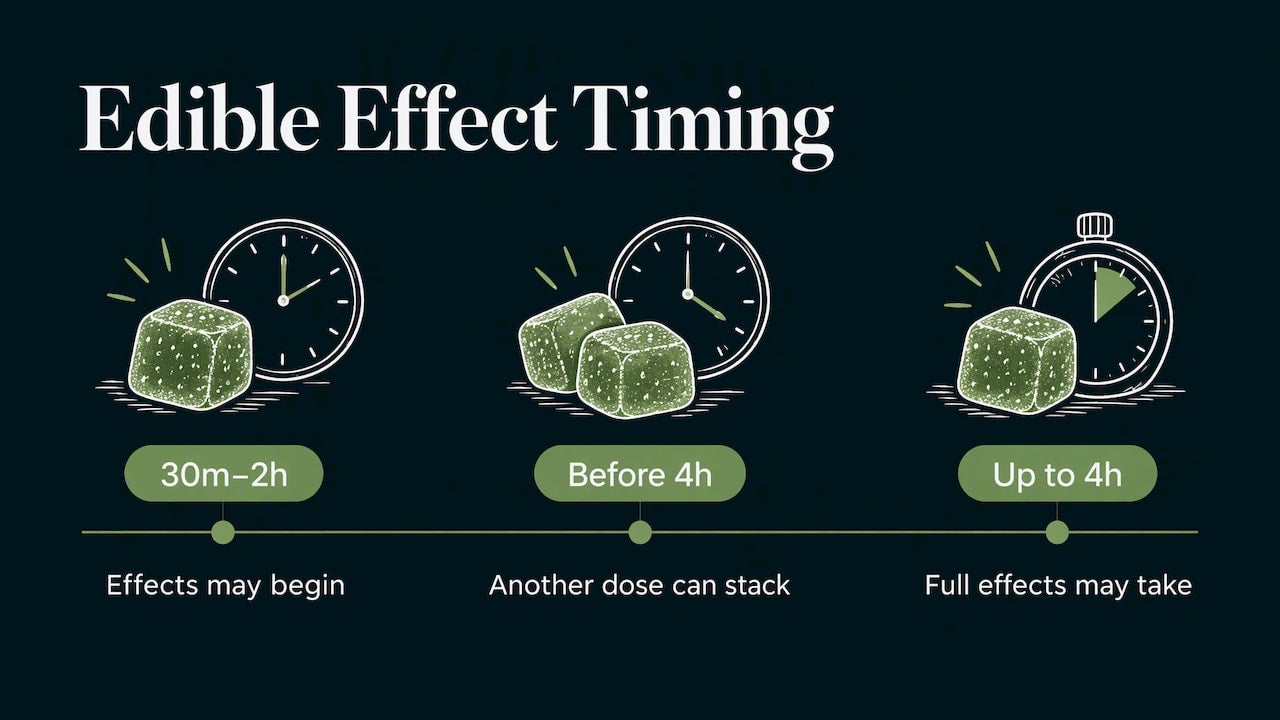
Edibles are where “go slow” matters most. When you eat cannabis, THC passes through digestion first. Health Canada says effects can begin anywhere from 30 minutes to 2 hours after eating, and it can take up to 4 hours to feel the full effect. Someone who feels nothing after 45 minutes and eats a second gummy has not found their dose. They have stacked two doses on top of each other, and both will arrive together.
Read the label, not the package size
In Canada, an edible package can contain up to 10 mg of THC in total. The Council of Chief Medical Officers of Health warns that this is a large amount for a first-time or infrequent user. Nova Scotia’s page makes the same point plainly: 10 mg is a limit, not a dose, and a beginner should start with 2.5 mg or less.
That means a package with four gummies at 2.5 mg each is built for exactly this approach: one piece, then wait. A single 10 mg chocolate means cutting it into quarters before you begin. Check the mg of THC per piece and the total in the package before anything else. Health Canada also reminds buyers that CBD products can contain THC, so read the label on those too.
How long to wait before a second dose
The sources differ slightly on the exact wait, and the safe reading is to take the longest one that fits your day:
- British Columbia: wait at least two hours before a second 2.5 mg dose.
- Québec: avoid taking more for the next two to three hours.
- The Canadian Centre on Substance Use and Addiction: wait at least four hours before consuming more, to avoid over-intoxication such as severe anxiety, panic, and nausea and vomiting.
If you are new, plan for the four-hour version. If you feel fine after four hours and want a little more, add another small dose of 2.5 mg, not a big step up. Our own beginner’s guide to edible dosing walks through how that works in practice.
Clear your schedule
The BC fact sheet says edible effects can last 4 to 12 hours, and some last up to 24 hours. So pick a day with nothing planned, no driving and no work. If you are curious how long THC stays detectable afterwards, we cover that in how long edibles stay in your system.
Vapes and flower: fast onset, same discipline
Inhaled cannabis is the opposite of edibles. Effects arrive in seconds to minutes, which makes it easier to judge a dose, but it also makes it easy to take too much because the next puff is right there.
Health Canada’s starting advice is one or two puffs of a product at 10% THC (100 mg/g) or less, then waiting up to 30 minutes for the full effect. Ottawa Public Health’s potency chart, taken from the Ontario Cannabis Store, helps you read what a percentage means:
| THC level | How it is described |
|---|---|
| 0 to 1.99% | Little to minimal |
| 2 to 6.99% | Very mild |
| 7 to 11.99% | Mild |
| 12 to 16.99% | Medium |
| 17 to 20% | Strong |
| Over 20% | Very strong |
So “10% or less” lands you in the mild band. Plenty of products sit well above that, which is fine for experienced users, but it is the reason a beginner should check the percentage before choosing.
Vaping habits that lower your risk
Health Canada’s lower-risk guidelines say smoking is likely the most hazardous way to use cannabis, and that vaporizers reduce key risks but are not risk-free. A few practical rules from the public health sources:
- Use only legal, regulated vaping products, and do not modify them or add substances such as nicotine.
- Avoid deep inhalation and breath-holding. A shallow puff is enough.
- Watch for cough, shortness of breath or chest pain, and see a health care provider if they show up.
Our THC cartridges and disposable vapes are listed by category so you can compare formats before you pick one.
Concentrates: why they come later
Hash, kief, wax, shatter, live resin and similar extracts are made to be strong. Health Canada says they contain high THC concentrations and that new or occasional users should avoid them, because higher THC means greater impairment and a higher risk of serious adverse effects. Nova Scotia’s page adds that extracts can contain up to 99% THC, and that regular use of high-strength products is linked with tolerance, withdrawal and cannabis use disorder.
For an enthusiast with an established tolerance, concentrates are a different category of experience, and the same principle still holds: use a tiny amount, wait, and step up only if you need to. For a new user, the sensible order is to learn your response on a low-THC edible or a mild flower first. When you are ready, our concentrates and oils are there. If you are wondering what counts as strong in edible form, our guide to high-dose THC edibles explains it.
A first-session plan you can follow
- Pick a safe setting. Choose a calm place at home, a day with no driving or obligations, and someone nearby if you can.
- Eat or drink something first. The BC fact sheet lists an empty stomach among the factors that change how an edible feels.
- Check the label. Find the mg of THC per piece for edibles, or the THC percentage for a vape or flower.
- Take the starting amount. That is 2.5 mg of THC or less for an edible, or one or two puffs at 10% or less for inhalation.
- Set a timer. Wait at least two hours for an edible, and four if you are new. For inhaled cannabis, wait up to 30 minutes.
- Do not redose just because you feel nothing yet. Silence at 45 minutes is normal for an edible.
- Add only a small step. If you decide to take more, add the same small amount again, not a larger one.
- Write it down. Note the product, the amount, the time and how it felt. Next time you will start from your own data instead of guessing.
If it turns out to be too much, the sources agree on the basics: stay somewhere safe, keep calm, and remember that the feeling passes. The BC fact sheet lists BC Poison Control at 1 800-567-8911 or 604-682-5050, and 911 for emergencies. Call 911 if you are in real distress or someone is unresponsive.
Safety around the dose
Driving and alcohol
Ottawa Public Health says cannabis impairs coordination, attention, judgement and reaction time for 6 to 12 hours, so use transit, a rideshare or walk. A peer-reviewed review of cannabis-impaired driving cites a Canadian guideline suggesting you abstain from driving for at least 6 hours after use, and notes that oral ingestion peaks at about 4 hours and can last 8 hours or longer. The same review says combining cannabis and alcohol causes more impairment than either alone, even at low alcohol levels. Health Canada’s consumer information also advises against mixing cannabis with alcohol or other intoxicating substances.
Medications and health conditions
Cannabis can interact with other drugs. Health Canada advises telling your health care practitioner about anything else you take. If you use prescription medication, are pregnant, or have a heart or mental health condition, ask your doctor or pharmacist before you start.
Storage
Edibles look like ordinary food, and Health Canada warns they can be life-threatening to children and pets. Keep them in their original child-resistant packaging, or in a clearly labelled container, away from food and out of reach.
Frequency
Starting low also means not using high-strength products too often. The BC fact sheet warns that using high-strength cannabis more than once a week can lead to tolerance and dependence, which pushes you toward larger doses over time.
Choosing products that fit the plan
The easiest way to follow the advice is to buy products that make it easy. Look for clearly labelled mg per piece, a mild THC percentage for flower and vapes, and formats you can split. At Toke Club, we have been serving Canadians since 2018, with edibles, vapes, flower, concentrates, topicals and accessories in one place.
If you are starting with edibles, browse our edibles category and look at the mg of THC listed for each product. Our site features a 25% off edibles offer, and our loyalty program earns you credits on purchases plus rewards for signing up. Our Potluck 1:1 gummies are one place to look if you want to see how a product with both THC and CBD is presented.
Once you know your own response, the rest of the catalogue opens up: flower, vapes and topicals. You can start from our home page at any time.
Our perspective
We built Toke Club around a simple idea: buying cannabis in Canada should be straightforward, and people should be able to find trusted products without friction. For us, “start low, go slow” is not a disclaimer. It is how a good first experience happens.
The people we serve range from first-time edible users to enthusiasts who know exactly what they want from a concentrate. A wide catalogue helps both. A beginner can pick a low-THC edible or a mild vape and follow the Health Canada numbers. An experienced customer can explore premium herb and concentrates with a tolerance they have already learned.
Because we offer everything from edibles to vapes to topicals, you can match the format to your plan instead of settling for whatever one store carries. Our loyalty program rewards you for coming back, so you can build your routine at your own pace, one small step at a time.
the author
FAQ
How long should I wait before taking more of an edible?
Wait at least two hours, and four if you are new. Health Canada says effects can take up to 4 hours to fully arrive. A second dose should be small, such as another 2.5 mg.
Is 10 mg a normal first dose?
No. Ten mg is the maximum THC allowed in one edible package in Canada, not a recommended dose. Public health sources advise starting with 2.5 mg or less, which for many products means a quarter or a single small piece.
Does start low, go slow apply to vapes too?
Yes. Take one or two puffs of a product at 10% THC or less and give it up to 30 minutes before deciding on more. Inhaled effects come fast, so the discipline is about not taking the next puff too soon.
What if I took too much?
Stay in a safe, calm place and remember the effects pass. Do not drive. If you feel very unwell, call your local poison control centre, or 911 in an emergency. In BC, Poison Control is 1 800-567-8911 or 604-682-5050.
Can I use cannabis and then drive after a few hours?
Canadian sources advise waiting at least 6 hours after use, and Ottawa Public Health says impairment can last 6 to 12 hours. After edibles it can last longer. If you are unsure, use transit, a rideshare or walk.
Sources
- Cannabis: lower your risks, Health Canada
- Canada’s lower-risk cannabis use guidelines, Health Canada
- CCMOH statement on cannabis extracts, edibles and topical products
- Lower Risk Cannabis Use, Ottawa Public Health
- Extracts and Topicals, Government of Nova Scotia
- Edible Cannabis, Cannabis Extracts and Cannabis Topicals, CCSA
- Cannabis-impaired driving and Canadian youth
Recommended
- High Dose THC Edibles in Canada: What Counts and How to Use Them
- Simple Beginner’s Guide On Edible Dosing
- How to Dose THC Shatter Safely: A Beginner’s Guide
- How Much Weed Do You Need for a Session?